

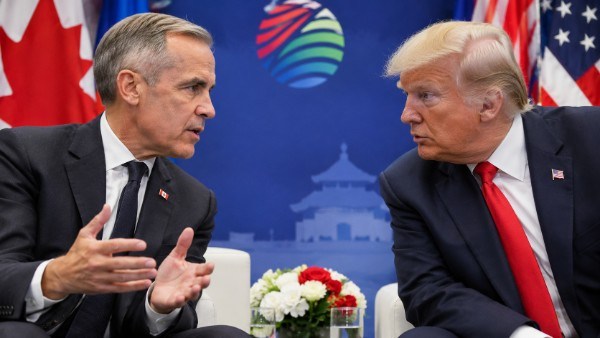
Canadian Prime Minister Mark Carney and US President Donald Trump have held talks on the sidelines of the APEC summit in China, discussing trade, economic cooperation and bilateral relations amid continuing disagreements over tariffs and the future of North American manufacturing.
Canadian Prime Minister Mark Carney met US President Donald Trump in Shenzhen, China, on Wednesday, November 18, during the Asia-Pacific Economic Cooperation (APEC) summit.
The meeting provided an opportunity for the two leaders to discuss the economic relationship between Canada and the United States at a time when trade tensions continue to affect businesses and industries on both sides of the border.
The talks come after months of disagreements over American tariffs, Canada’s automotive sector and Ottawa’s efforts to diversify its international trade relationships.
Although both governments have expressed interest in maintaining cooperation, several important issues remain unresolved.
Carney and Trump Hold Talks on the Sidelines of APEC
The two leaders met during the international gathering in Shenzhen, where several major economies are discussing trade, investment and regional security.
Their meeting comes shortly after Carney’s discussions with Chinese President Xi Jinping, which resulted in additional Chinese tariff concessions for Canadian agricultural and seafood exports.
Carney has been seeking to expand Canada’s economic relationships with countries beyond the United States, while maintaining the importance of the country’s largest trading partnership.
Trump, meanwhile, has continued to emphasise his administration’s priorities of strengthening American manufacturing, reducing trade deficits and encouraging companies to invest in the United States.
The meeting offered both leaders an opportunity to address these competing economic priorities directly.
Automotive Tariffs Remain a Major Issue
One of the most important subjects in Canada-US relations is the automotive industry.
The two countries share deeply integrated vehicle manufacturing supply chains, with automotive parts and finished vehicles regularly crossing the border during production.
American tariffs on Canadian automotive products have created uncertainty for manufacturers, suppliers and workers.
Carney has argued that Canada’s automotive sector should be protected and that Canadian factories must remain an important part of North American manufacturing.
The prime minister has also indicated that Canada could consider greater cooperation with Chinese automakers if negotiations with Washington fail to produce favourable conditions for Canadian industry.
That possibility has attracted criticism from officials close to the Trump administration, who are concerned about Chinese companies gaining greater access to the North American automotive market.
The issue is likely to remain an important point of disagreement between Ottawa and Washington.
Canada Looks Beyond the US for Trade Opportunities
Carney’s meeting with Trump follows a series of diplomatic engagements aimed at diversifying Canada’s international trade.
During his recent visit to China, the Canadian prime minister secured additional tariff reductions for Canadian pork, seafood and other agricultural products.
The agreement is expected to improve access to the Chinese market for Canadian exporters and strengthen commercial relations between the two countries.
Canada has also been exploring opportunities in Europe, Southeast Asia and other emerging markets.
The government’s broader objective is to increase international trade while reducing the economic risks associated with excessive dependence on a single trading partner.
However, the United States remains Canada’s most important economic relationship, making a major deterioration in bilateral ties costly for both countries.
APEC Summit Brings Major Economies Together
The meeting took place during the APEC Economic Leaders’ Meeting, which brings together governments from across the Asia-Pacific region.
The summit focuses on economic growth, international trade, investment, technological development and regional cooperation.
This year’s gathering is particularly significant because it comes amid continuing competition between the United States and China.
Trade restrictions, semiconductor technology, artificial intelligence and access to critical minerals have become major issues in international economic relations.
Carney has used the summit to promote Canada’s position as a reliable trading partner and an attractive destination for international investment.
Trump’s participation is also part of a wider Asian diplomatic tour involving meetings with Chinese President Xi Jinping and Russian President Vladimir Putin.
Canada-US Relations Face a Difficult Period
Despite their close economic relationship, Canada and the United States have experienced considerable tensions over the past year.
Trump’s tariff policies have affected several Canadian industries, including steel, aluminium, automobiles and other manufactured products.
The American president has also repeatedly criticised Canada’s trade policies and questioned aspects of the economic relationship between the two countries.
Carney has responded by emphasising Canadian economic sovereignty and the need to protect domestic industries.
The disagreements have created uncertainty for businesses that depend on cross-border supply chains.
Manufacturers in both countries face difficult decisions involving investment, production locations and future employment.
The Future of North American Trade
Another important issue facing the two governments is the future of the United States-Mexico-Canada Agreement (USMCA).
The trade agreement provides the framework for economic cooperation between the three North American countries.
Its upcoming review is expected to involve difficult negotiations over tariffs, rules of origin, manufacturing and market access.
For Canada, maintaining reliable access to the American market is particularly important for its automotive, energy, agricultural and manufacturing industries.
For the United States, the agreement is also important because American companies depend on Canadian raw materials, energy supplies and industrial components.
Any major changes to the agreement could have consequences for businesses and consumers across the continent.
What the Meeting Means for Canada
The Carney-Trump meeting comes at a critical time for Canada’s economic strategy.
Ottawa wants to maintain its close relationship with Washington while expanding trade opportunities with other major economies.
The challenge is to secure better market access and protect Canadian manufacturing without creating additional friction with the United States.
For Trump, the discussions provide another opportunity to press Canada’s government on trade policies and American economic priorities.
For Carney, maintaining a stable relationship with Washington remains essential, even as Canada pursues greater economic independence.
A Key Moment for Bilateral Relations
The meeting at the APEC summit represents another important diplomatic engagement between the two leaders.
Although discussions may help maintain communication and identify areas of cooperation, major disagreements over tariffs, automotive investment and trade policy remain.
The coming months will be important as Canada and the United States prepare for further negotiations on their economic relationship.
For businesses and workers on both sides of the border, the central concern is whether the two governments can establish a more predictable trading environment.
The outcome will have implications not only for Canada and the United States but also for the wider North American economy.
Source: Reuters, The Canadian Press, CBC News, Global News and official Canadian government statements, November 18, 2026.