

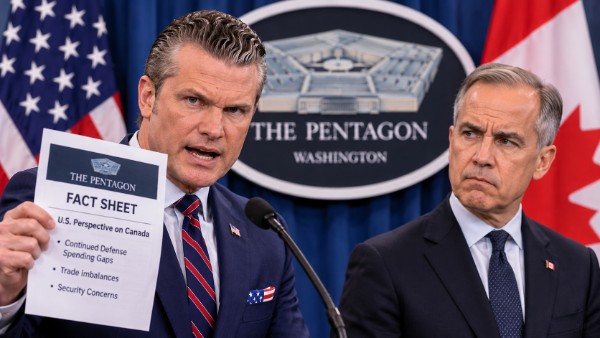
The US Department of Defense has publicly questioned Canada’s military readiness, defence spending and commitment to North American security. The criticism follows a classified directive from Defence Secretary Pete Hegseth restricting certain interactions between American and Canadian military officials, adding further pressure to an already strained relationship between Washington and Ottawa.
By CK Sharma | World Affairs | NewsBee Media Inc.
The Pentagon has issued a strongly worded fact sheet criticising Canada’s defence capabilities, accusing the country of failing to make the necessary investments and decisions required to become a reliable partner in protecting North America.
The document, released publicly on November 23, 2026, highlights what the US Department of Defense describes as serious weaknesses in Canada’s air, land and naval capabilities. It also questions Ottawa’s progress towards meeting NATO’s latest defence investment commitments.
The publication follows a classified memo issued by US Defence Secretary Pete Hegseth last week, which introduced restrictions on certain forms of military cooperation and interaction between American and Canadian officials.
The developments have raised concerns about the future of the long-standing defence relationship between the two neighbouring countries, particularly as both remain closely connected through NATO and the North American Aerospace Defense Command (NORAD).
Pentagon Accuses Canada of Falling Behind on Defence
The Pentagon’s fact sheet argues that Canada has not made sufficient progress in modernising its armed forces or addressing long-standing military readiness problems.
It claims that Canada has yet to make the difficult financial and political decisions needed to fulfil its NATO Defence Investment Pledge and become a credible partner in defending the continent.
The document states that Canada’s defence shortfalls are affecting its ability to contribute meaningfully to North American security.
According to figures presented by the Pentagon, only 41.9 per cent of Canada’s air force fleet was serviceable during the 2025-26 fiscal year. The report also claims that 53.9 per cent of the naval fleet was serviceable, while the Canadian Army’s operational readiness stood at 48 per cent.
These figures have been used by Washington to argue that Canada remains heavily dependent on American military capabilities.
The Pentagon also criticised Ottawa for prioritising domestic economic and commercial interests over military effectiveness, suggesting that its approach could create uncertainty within NORAD.
The criticism represents an unusually direct public challenge to a country that has traditionally been one of Washington’s closest defence partners.
Hegseth’s Memo Introduces Restrictions on Military Cooperation
The Pentagon’s fact sheet follows a classified memo issued by Defence Secretary Pete Hegseth restricting certain interactions between American military personnel and their Canadian counterparts.
The restrictions reportedly focus on participation in think-tank events, social engagements and other non-operational activities involving Canadian officials.
The move has attracted attention because military cooperation between the United States and Canada has traditionally extended beyond formal defence operations.
However, American officials have indicated that the restrictions do not affect joint military operations or intelligence sharing.
Republican Senator Mike Rounds also sought to reassure Canadians, saying at the Halifax International Security Forum that the changes would not interfere with military operations.
Pentagon spokesperson Sean Parnell said the department was taking steps to ensure its engagement with Canada advanced tangible American defence objectives.
The restrictions have nevertheless raised questions about whether Washington is deliberately using defence cooperation as a means of pressuring Ottawa.
Canada Defends Its Defence Spending Commitments
Canada has rejected the suggestion that it is failing to take defence modernisation seriously.
Prime Minister Mark Carney’s government has announced significant increases in military spending, including a commitment of C$81.8 billion over five years to rebuild the Canadian Armed Forces.
A spokesperson for Canada’s Defence Minister David McGuinty said the country had already reached NATO’s previous target of spending two per cent of gross domestic product on defence ahead of schedule.
Ottawa has also stated that it remains on track to meet NATO’s new defence investment commitments by 2035.
The Canadian government argues that its recent budget and military modernisation plans demonstrate a clear commitment to improving national security.
However, questions remain about how quickly the additional funding can translate into operational capabilities.
Modernising military equipment requires long-term procurement agreements, trained personnel, maintenance infrastructure and reliable supply chains. These challenges cannot necessarily be resolved through increased spending alone.
Canada therefore faces the difficult task of improving its military readiness while managing the financial and industrial consequences of a major defence expansion.
The F-35 Fighter Jet Dispute Adds Further Tension
One of the most important issues behind the Pentagon’s criticism is Canada’s ongoing review of its planned purchase of American-made F-35 fighter jets.
Canada had previously committed to purchasing 88 F-35 aircraft manufactured by Lockheed Martin to replace its ageing fighter fleet.
However, the Carney government has been reviewing the agreement amid growing trade and political tensions with Washington.
Ottawa has also considered alternatives, including Sweden’s Saab Gripen fighter aircraft.
The Pentagon has criticised the possibility of Canada operating a mixed fleet of fighter jets, arguing that maintaining different aircraft platforms could increase costs, complicate maintenance and worsen existing personnel shortages.
For Washington, the issue is not simply about which aircraft Canada purchases. It also concerns the future of defence industrial cooperation between the two countries.
For Canada, however, purchasing military equipment from alternative suppliers could provide greater domestic industrial participation and reduce dependence on American manufacturers.
The disagreement reflects a broader question about whether Canada should continue relying heavily on US defence suppliers or develop a more diversified military procurement strategy.
NORAD and North American Security at the Centre
The growing disagreement is particularly significant because the United States and Canada share responsibility for defending North American airspace through NORAD.
Established in 1958, the organisation provides aerospace warning, aerospace control and maritime warning for both countries.
Its effectiveness depends on close coordination, shared intelligence, compatible military equipment and the ability to respond quickly to potential threats.
The Pentagon’s concerns about Canadian military readiness therefore have direct implications for the future of continental defence.
Washington argues that Canada must increase its contribution to ensure that the United States does not carry a disproportionate share of the responsibility.
Ottawa, meanwhile, maintains that cooperation remains strong and that its military modernisation programme is moving forward.
Canadian Defence Minister David McGuinty described the relationship between the two militaries as business as usual during the Halifax International Security Forum.
He also assured Canadians that defence, security and intelligence cooperation continued.
Nevertheless, the latest developments suggest that political disagreements are increasingly affecting the atmosphere surrounding an otherwise long-standing military partnership.
A Wider Political Dispute Between Washington and Ottawa
The Pentagon’s criticism cannot be viewed separately from the broader deterioration in relations between the United States and Canada.
Since Donald Trump returned to the White House, disagreements over trade, tariffs and Canadian sovereignty have placed considerable pressure on the bilateral relationship.
Trump has repeatedly criticised Canada’s trade policies and previously suggested that the country could become the 51st US state.
Canada has strongly rejected those remarks and has increasingly explored ways to diversify its economic and defence relationships.
The F-35 review is part of this wider shift, as Ottawa considers whether European suppliers could provide alternative military capabilities.
The Pentagon’s fact sheet also comes after Washington paused the Permanent Joint Board on Defense, a bilateral advisory body established in 1940 to support defence cooperation between the two countries.
These developments suggest that the relationship is facing challenges beyond military spending alone.
What Lies Ahead for Canada-US Defence Relations?
Despite the criticism, both countries remain important security partners.
Their shared border, interconnected economies and common responsibilities within NATO make a complete breakdown in defence cooperation unlikely.
However, the latest dispute highlights the growing importance of military spending, procurement decisions and strategic independence in Canada’s relationship with Washington.
Canada will need to demonstrate that its increased defence budgets can deliver practical improvements in military readiness.
At the same time, the United States will need to consider whether publicly criticising a close ally and restricting traditional military interactions strengthens or weakens North American security.
The future of the F-35 agreement, Canada’s plans to modernise its military and the implementation of NATO’s new spending commitments will remain important issues in the months ahead.
Conclusion
The Pentagon’s criticism of Canada marks another difficult moment in the relationship between two countries that have historically maintained close defence and security cooperation.
Washington’s concerns about military readiness and defence spending are not new. However, the decision to publish a sharply worded fact sheet following Hegseth’s classified memo demonstrates a more confrontational approach towards Ottawa.
Canada has responded by defending its recent investments and reaffirming its commitment to NATO and continental security.
Ultimately, the challenge for both governments will be to ensure that political disagreements do not undermine the military cooperation that protects their shared interests.
While Canada must continue strengthening its armed forces, the United States must also recognise that a strong and independent Canadian defence capability is important to the security of the entire North American continent.