

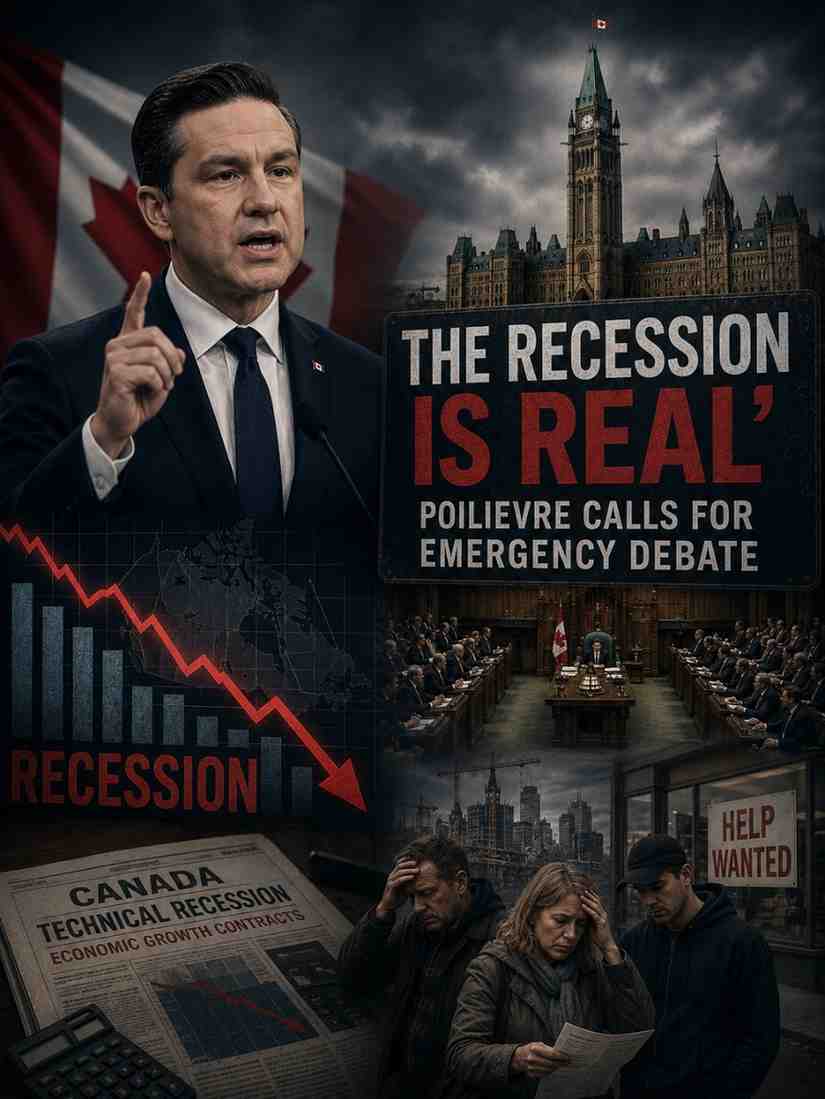
Conservative Leader Pierre Poilievre is calling for an emergency debate in Parliament after Canada slipped into what many economists describe as a technical recession. Poilievre argued that Canadians are facing a worsening economic crisis and urged Prime Minister Mark Carney to explain how the government plans to reverse the slowdown. The development matters nationally as concerns grow over jobs, affordability, and economic growth.
Background and Context
Statistics Canada recently reported that the country’s economy contracted for a second consecutive quarter, meeting a common definition of a technical recession. The first quarter of 2026 saw GDP decline by 0.1 per cent on an annualized basis after a revised one per cent contraction in the final quarter of 2025.
The slowdown comes amid high borrowing costs, weaker consumer spending, investment declines, and continued global economic uncertainty linked to trade tensions and international conflicts.
While some economists argue the downturn is relatively mild and may not represent a full recession, others acknowledge that economic growth has remained weak for an extended period.
Latest Developments
In a public letter to Prime Minister Mark Carney, Pierre Poilievre called for an emergency parliamentary debate focused on Canada’s economic situation.
Poilievre argued that the country is facing a genuine recession and pointed to rising insolvencies, job losses, declining business investment, and growing food bank usage as evidence of broader economic distress.
“The recession is real,” Poilievre wrote, urging the government to explain its plan for economic recovery and reverse what he described as failed policies.
The Conservative leader also criticized the government’s handling of the economy, saying Canada is the only G7 country currently experiencing a recession by that measure.
Meanwhile, Finance Minister François-Philippe Champagne has defended the government’s economic approach, saying Ottawa remains focused on long-term investments in housing, infrastructure, and innovation.
Why This Matters
The debate highlights growing political pressure on the federal government as Canadians face affordability challenges and economic uncertainty.
If economic weakness continues, it could affect employment, investment, housing markets, and government finances across the country.
The issue is also likely to become a major political battleground between the Liberals and Conservatives in the months ahead.
What Happens Next
Parliament could face increased pressure to hold a formal emergency debate on the economy.
Economists and financial markets will continue monitoring growth, inflation, employment, and interest rate trends for signs of either recovery or further slowdown.
Political leaders are expected to intensify arguments over how best to address Canada’s economic challenges.
Conclusion
Pierre Poilievre’s call for an emergency debate underscores growing concern over Canada’s economic direction as recession fears intensify.
With political pressure mounting and economic indicators under close scrutiny, the coming months could prove critical for both the government and Canadian households.