

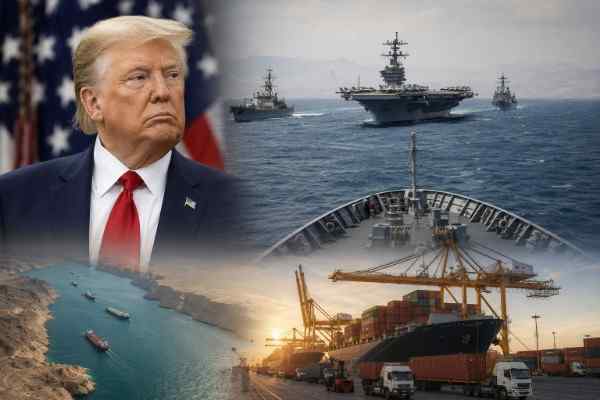
White House Drops Controversial Transit Charge While Tightening Pressure on Iran Through Renewed Maritime Restrictions
Summary
U.S. President Donald Trump has reversed his proposal to impose a 20% fee on cargo passing through the Strait of Hormuz, opting instead to pursue trade and investment agreements with Gulf nations. At the same time, the United States is moving ahead with plans to reinstate its naval blockade of Iranian ports, increasing pressure on Tehran amid escalating tensions in the Gulf.
The policy shift comes after discussions with regional leaders and follows renewed military exchanges between the United States and Iran. While the controversial transit fee has been abandoned, Washington has made clear that vessels involved in trade with Iranian ports will continue to face strict restrictions under the renewed blockade.
Trump Drops Controversial Cargo Fee
Just one day after announcing that ships using the Strait of Hormuz would be required to pay a 20% reimbursement fee for U.S. security protection, President Trump confirmed that the proposal would not move forward.
According to the White House, the decision followed productive discussions with Gulf partners, who instead pledged to expand trade and investment cooperation with the United States. Trump argued that long-term economic agreements would provide greater benefits than collecting transit fees from commercial vessels using one of the world’s busiest shipping routes.
Iran Ports Blockade to Continue
Although the cargo fee has been withdrawn, the United States is pressing ahead with plans to restore a naval blockade targeting Iranian ports. Under the renewed policy, ships conducting business with Iran or transporting cargo to and from Iranian ports could face interception or other enforcement measures by U.S. forces.
The Trump administration says the blockade is intended to weaken Iran’s ability to finance military operations and to respond to recent attacks on commercial shipping and regional allies. U.S. officials maintain that freedom of navigation through the Strait of Hormuz will continue for vessels not engaged in trade with Iran.
Rising Tensions in the Gulf
The latest announcement comes as military tensions remain high across the Middle East. Recent U.S. airstrikes on Iranian military facilities have been followed by Iranian attacks on commercial vessels and regional targets, increasing concerns about a broader conflict.
Iran has continued to challenge U.S. naval operations in the Strait of Hormuz, one of the world’s most critical energy corridors. The strategic waterway carries a significant share of global oil and liquefied natural gas exports, making any disruption a major concern for international markets.
Global Economic Impact
The initial proposal for a 20% cargo fee had raised concerns among shipping companies, energy producers, and international trading partners about increased transportation costs and higher fuel prices. Although the fee has now been dropped, uncertainty surrounding the renewed blockade continues to weigh on global markets.
Shipping operators are closely monitoring the evolving security situation, while energy analysts warn that prolonged instability in the Gulf could continue to affect oil prices, insurance costs, and international supply chains. Governments across the region are also reviewing contingency plans should tensions escalate further.
Conclusion
President Donald Trump’s decision to abandon the proposed 20% cargo fee while reinstating the blockade of Iranian ports marks a significant shift in U.S. strategy toward the Strait of Hormuz. Although commercial vessels using the waterway will avoid the controversial transit charge, the renewed blockade signals continued pressure on Iran as military and diplomatic tensions remain high. With global energy markets closely watching developments, the situation is expected to remain a major focus for governments, businesses, and international security officials in the coming weeks.