

Maritime Attack Raises Regional Tensions While Millions Gather to Honor Iran’s Late Supreme Leader
Summary
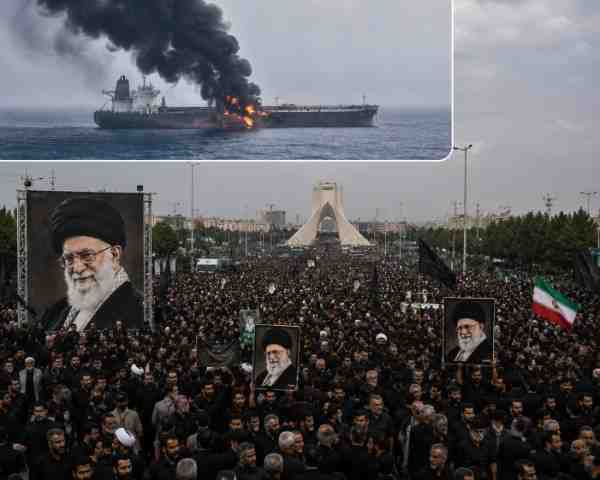
Qatar has accused Iran of attacking a Qatari liquefied natural gas (LNG) tanker in the Strait of Hormuz, marking a significant escalation in tensions across the Gulf. The incident occurred as hundreds of thousands of mourners gathered in Iran to pay their final respects to former Supreme Leader Ayatollah Ali Khamenei during large-scale funeral ceremonies. The attack has heightened concerns over maritime security in one of the world’s most important energy shipping routes while casting further uncertainty over fragile regional peace efforts.
Tanker Hit in Strategic Waterway
According to Qatari officials, the LNG tanker was struck while transiting near the Strait of Hormuz, causing a fire in the vessel’s engine room. The crew was reported safe, and emergency teams quickly responded to contain the blaze.
Qatar has held Iran fully responsible for the attack, describing it as a serious violation of international law and a threat to freedom of navigation. Although Iranian authorities have not officially accepted responsibility, reports indicate that the vessel was allegedly targeted after using a shipping route opposed by Tehran. The incident has renewed fears about the security of commercial shipping through the strategic waterway.
Funeral Ceremonies Draw Massive Crowds
The maritime incident unfolded as enormous crowds gathered across Iran to mourn Ayatollah Ali Khamenei. Funeral processions in Tehran and the holy city of Qom attracted hundreds of thousands of people, with mourners carrying portraits of the late leader, waving Iranian flags, and participating in religious prayers.
Senior government officials, military commanders, and religious leaders attended the ceremonies, which have been presented by Iranian authorities as a demonstration of national unity following Khamenei’s death. The country remains in an extended period of national mourning, with additional funeral events planned in the coming days.
Rising Regional and Global Concerns
The reported attack has intensified concerns over the stability of the Strait of Hormuz, a vital maritime corridor through which a substantial share of the world’s oil and liquefied natural gas exports passes each day.
Energy markets reacted cautiously as traders monitored the situation, while shipping companies reviewed security measures for vessels operating in the region. Several governments have also called for restraint, warning that further attacks on commercial shipping could disrupt global energy supplies and international trade.
Diplomatic efforts to ease tensions between Iran and Western nations remain stalled, adding to uncertainty over the region’s security outlook.
Diplomatic Fallout
Qatar, which has often played a mediating role in regional disputes, strongly condemned the attack and urged Iran to respect international maritime law. The incident may further complicate diplomatic efforts aimed at reducing tensions following months of conflict in the Middle East.
Meanwhile, international observers continue to monitor both the security situation in the Gulf and Iran’s political transition following Khamenei’s death. Analysts believe the combination of military incidents and domestic mourning could shape regional dynamics in the weeks ahead.
Conclusion
Qatar’s accusation that Iran struck a tanker in the Strait of Hormuz has added a new layer of tension to an already volatile region. The incident comes at a time when Iran is mourning the loss of Ayatollah Ali Khamenei, with massive funeral gatherings taking place across the country. As investigations continue and diplomatic efforts struggle to gain momentum, governments and global markets will be closely watching developments in one of the world’s most strategically important maritime corridors.