

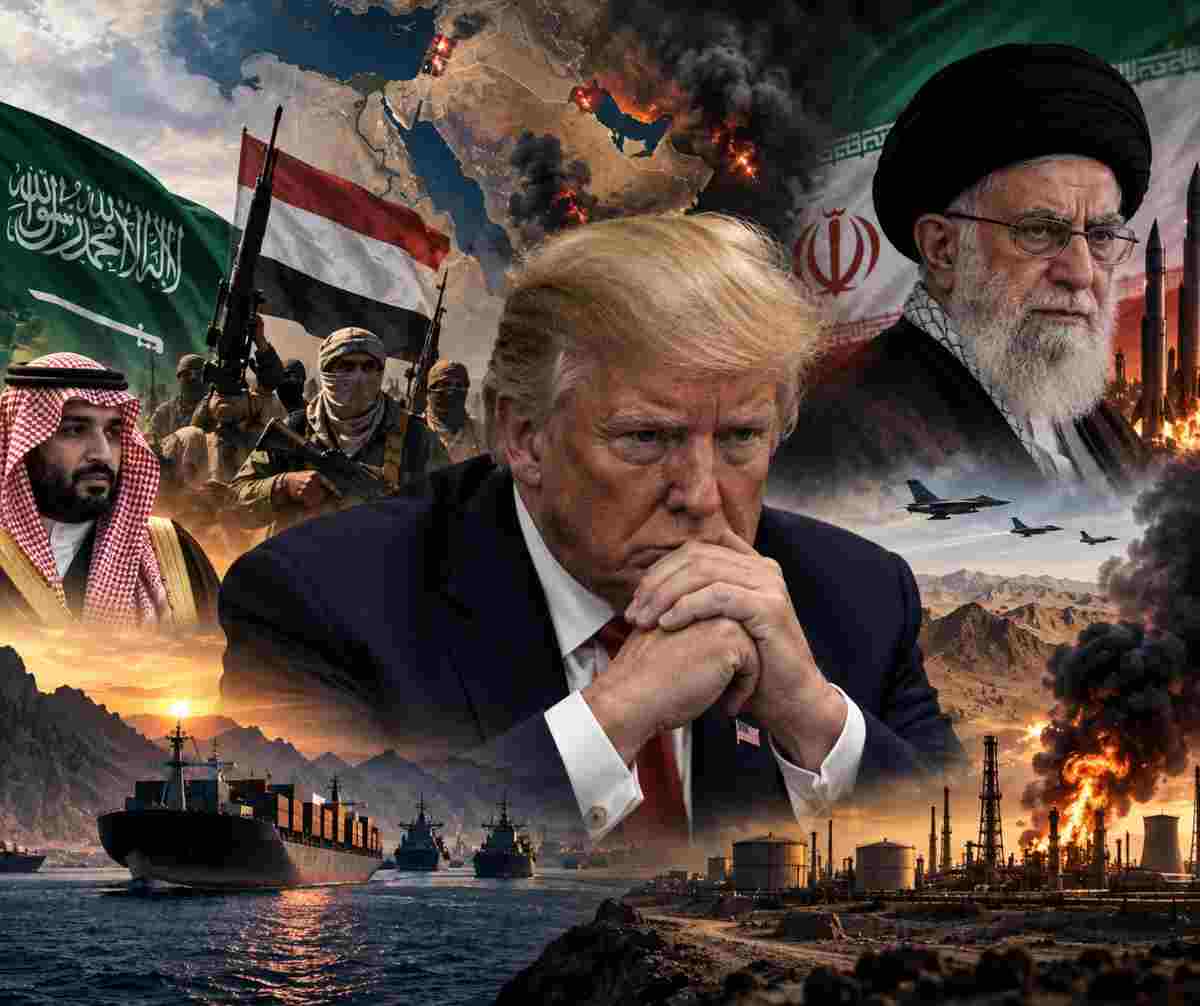
As the conflict spreads from Iran to Yemen and the Gulf, Washington faces a growing challenge: ending the war without opening another front
By CK Sharma
Summary
What began as a confrontation between the United States and Iran has become a much wider regional crisis. More than six months into the war, the conflict has spread into Yemen and the Red Sea, while Iran-backed Houthi forces have intensified attacks on Saudi Arabia and moved closer to strategically important maritime routes. President Donald Trump has repeatedly suggested that the war is moving toward an end, but the latest developments tell a more complicated story. The United States has made progress around the Strait of Hormuz and put significant pressure on Iran’s economy, yet the emergence of new fronts means Washington is still dealing with consequences far beyond Iran itself. The question is no longer simply whether the United States can pressure Tehran, but whether it can bring the wider conflict to a controlled end.
A War That Refuses to Stay Contained
When the United States and Israel launched their campaign against Iran earlier this year, the central focus was Iran’s nuclear programme, military capabilities and regional influence.
Months later, the geography of the conflict looks very different.
Iran remains under intense military and economic pressure, but the fighting has spread into areas that directly affect America’s regional partners and the global economy. Yemen’s Iran-aligned Houthis have launched increasingly serious attacks against Saudi Arabia, while their recent territorial gains have brought them closer to the Bab el-Mandeb Strait, one of the world’s most important shipping routes.
On September 20, Saudi Arabia’s stock market and other Gulf markets fell after the Houthis claimed missile and drone attacks on Riyadh. Saudi authorities have also confirmed an attempted ballistic missile attack on the capital.
That development matters because Saudi Arabia is not Iran.
Every additional front increases the number of governments, military forces and economic interests that Washington has to consider.
Trump Says the War Is Nearing Its End
President Donald Trump has repeatedly projected confidence about the direction of the conflict.
But the situation on the ground is harder to simplify.
Reuters reported this week that Trump has said he hopes the Iran war is nearing its end, while fighting involving the Houthis and Saudi Arabia has continued to intensify. The United States has also been reluctant to provide direct military support to Saudi Arabia against the Houthis, adding another complication to Washington’s relationship with its Gulf partners.
For Trump, the challenge is now twofold.
The administration wants to maintain pressure on Iran while avoiding a wider war involving several regional powers. At the same time, America’s allies expect Washington to respond when their territory or infrastructure comes under attack.
Those objectives can pull in opposite directions.
If Washington intervenes more aggressively, it risks expanding the war. If it holds back, allies may question how far American security commitments actually extend.
The Houthi Factor Has Changed the Equation
The Houthis have become one of the most important variables in the conflict.
Their recent advance along Yemen’s Red Sea coast has reportedly given them greater control around the Bab el-Mandeb area. Reuters reported that the group seized strategically important territory and islands, strengthening its position near the maritime chokepoint.
The significance goes well beyond Yemen.
Bab el-Mandeb connects the Red Sea with the Gulf of Aden and is a major route for international shipping. If shipping becomes unsafe, vessels may have to take longer routes around Africa, increasing transportation costs and delivery times.
The Houthis have already demonstrated their willingness to use missiles and drones against regional targets and shipping.
That means Washington is now facing a conflict where controlling the battlefield in Iran does not necessarily mean controlling the wider regional consequences.
Saudi Arabia Is Under Growing Pressure
Saudi Arabia has increasingly found itself caught between its relationship with Washington and the immediate threat from the Houthis.
The latest attacks have targeted or threatened Saudi cities, energy infrastructure and transport routes. Saudi Arabia has also sought additional air-defence assistance from other countries as the attacks intensify. Turkey has said it is prepared to help meet Saudi military requirements under a recently signed defence agreement involving Turkey, Saudi Arabia and Pakistan.
That development is significant.
For decades, Saudi Arabia has relied heavily on its relationship with the United States for security. The current crisis is testing that arrangement at a particularly sensitive moment.
Trump’s decision not to provide direct military support against the Houthis has therefore attracted considerable attention.
It does not necessarily mean Washington is abandoning Riyadh. But it does show that the administration is trying to avoid being pulled deeper into another military front.
The Oil Problem Is Getting Bigger
Perhaps the strongest argument against declaring the war close to an end is the pressure on global energy markets.
The Strait of Hormuz remains heavily disrupted, while the fighting around the Red Sea creates another threat to shipping. Together, the two maritime routes are crucial to the movement of energy and goods.
Reuters reported that Brent crude remained above $100 a barrel despite a recent daily decline, while disruptions to Saudi infrastructure put a portion of global oil supply at risk.
For ordinary consumers, the consequences eventually appear in fuel prices, transportation costs and the price of goods.
For governments, the problem is even larger.
A prolonged energy shock could create inflationary pressure at a time when many economies are already dealing with slower growth and higher borrowing costs.
This means the Iran war is no longer simply a Middle Eastern security issue. It has become an international economic problem.
Iran Is Still Looking for a Way Back to Negotiations
Despite the continued fighting, diplomacy has not disappeared.
Iran has conveyed conditions to mediators for returning to negotiations aimed at ending the war. According to reporting citing Reuters, Tehran has called for an end to the war on all fronts, the unfreezing of Iranian funds and an end to the naval blockade. Qatar and Pakistan have been involved in mediation efforts.
That is important because it suggests that both sides still see some value in diplomacy.
The problem is the distance between their positions.
Washington wants guarantees on Iran’s nuclear programme and regional activities. Tehran wants the military pressure and economic blockade reduced before it makes major commitments.
Neither side appears willing to give the other everything it wants.
So, Is Trump Losing Control?
The evidence does not establish that the Trump administration has simply lost control of the conflict.
The United States has achieved some of its military objectives and has put substantial pressure on Iran. The Strait of Hormuz has also seen efforts to reopen shipping, and Iran’s ability to export oil has been heavily constrained.
But control is a different question from military success.
A conflict can be militarily dominated in one area while becoming harder to manage politically and regionally.
That appears to be the challenge facing Washington now.
The emergence of a stronger Houthi front, attacks on Saudi Arabia, continuing disruption around major shipping routes and the difficulty of reaching a durable agreement with Tehran all suggest that ending the war will be more complicated than starting it.
The Bigger Test for Trump
The real test for President Trump may not be whether the United States can inflict more damage on Iran.
It may be whether he can prevent the conflict from becoming permanent.
A prolonged war would continue putting pressure on oil markets, American military resources and Washington’s relationships with regional partners. It would also give Iran and its allies more opportunities to create new pressure points.
For Trump, therefore, the next phase may require something different from military pressure: diplomacy capable of producing an agreement that Iran can accept and America’s allies can trust.
That is a considerably harder task.
Conclusion
The question of whether Donald Trump is losing control of the Iran war cannot be answered simply with a yes or no.
The United States still has enormous military and economic power, and Washington has managed to put significant pressure on Tehran. But the conflict has expanded in ways that make a clean ending increasingly difficult.
The Houthi advance in Yemen, attacks on Saudi Arabia, pressure on the Bab el-Mandeb and continuing disruption around the Strait of Hormuz have created a conflict with multiple moving parts.
That is where the real danger lies.
Trump may still be able to shape how the war ends, but the longer the conflict continues, the more difficult it becomes to control every consequence.
For Washington, the objective now is not simply to win another battle. It is to stop a regional war from becoming a permanent part of the Middle East’s political landscape.
And that may prove to be President Trump’s most difficult challenge yet.
CK SHARMA TORONTO ( EDITOR IN CHIEF )