

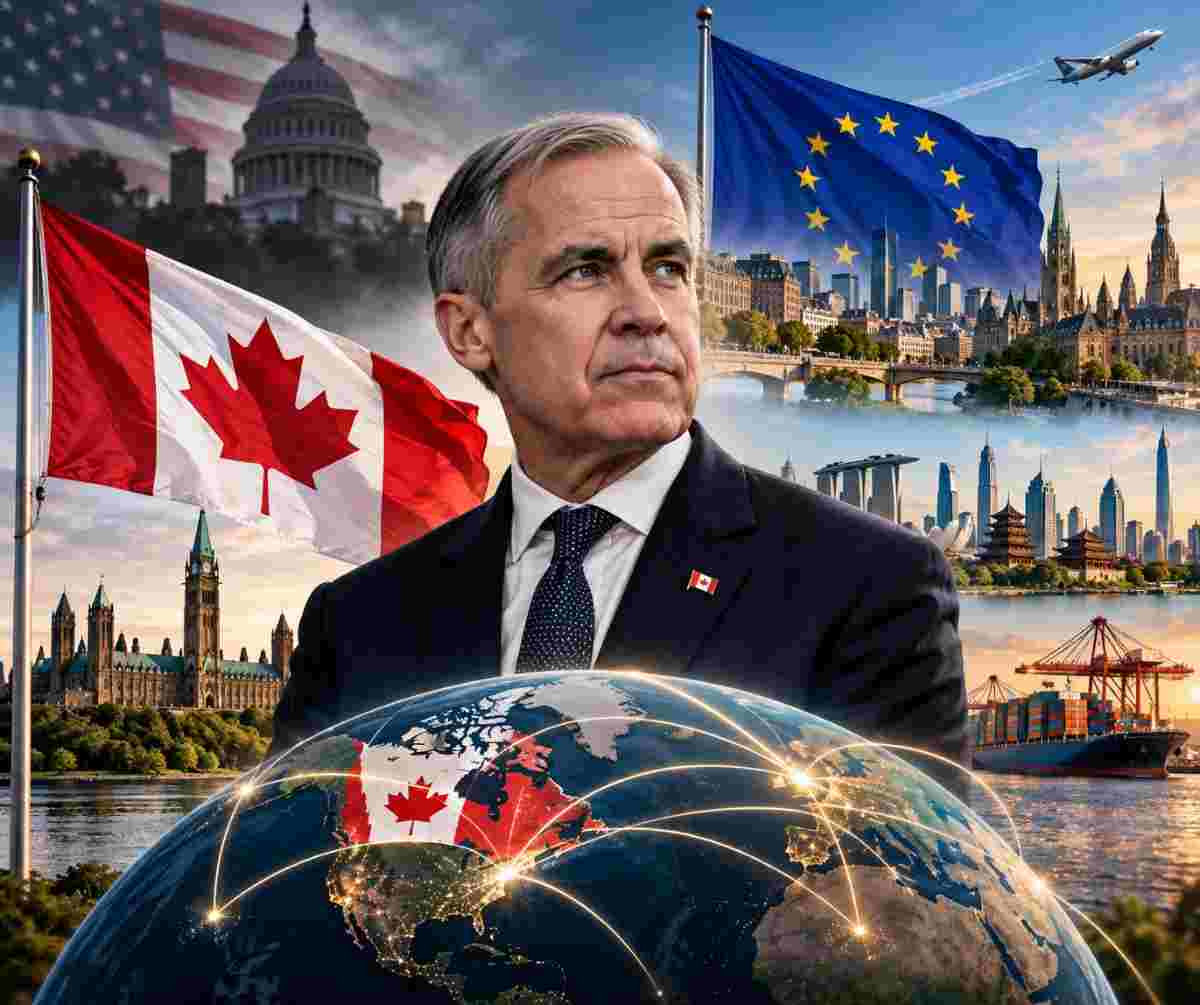
Ottawa is deepening ties with Europe and Asia as Canada reassesses its economic and strategic position in a changing world
By CK SHARMA TORONTO ( EDITOR IN CHIEF )
For decades, Canada’s position in the world was closely tied to one overwhelming reality: its relationship with the United States. Geography, trade, defence and supply chains all made Washington Ottawa’s most important international partner.
Under Prime Minister Mark Carney, however, Canada’s foreign policy is increasingly showing another side.
Ottawa is strengthening its relationship with the European Union, expanding trade discussions with Southeast Asia and looking for new opportunities in energy, critical minerals, technology and defence. At the same time, Canada continues to maintain its relationship with the United States, making the country’s current strategy less about abandoning Washington and more about reducing its dependence on a single economic partner.
That raises a bigger question: Is Mark Carney changing Canada’s global strategy?
Canada Turns Toward Europe
The clearest sign of the shift has come from Europe.
In September, European Commission President Ursula von der Leyen opened the door to Canada becoming the European Union’s first “associate member.” The idea is unprecedented and its exact legal and economic meaning has yet to be worked out, but it signals how quickly Canada-EU relations are developing.
Carney welcomed the proposal during his visit to Europe and has pushed for deeper cooperation in areas including trade, defence, energy, science, technology and critical minerals.
The proposal does not mean Canada is seeking full EU membership. Carney has also stressed that Canadian sovereignty would remain intact.
Still, the political symbolism is significant.
Canada is geographically part of North America, but Ottawa is increasingly presenting itself as a country capable of building stronger economic and strategic relationships across the Atlantic and beyond.
The U.S. Relationship Is Still Crucial
It would be misleading, however, to describe Canada’s approach as a simple move away from the United States.
The two countries remain deeply connected through trade, investment, manufacturing, energy and security. Canada cannot quickly replace that relationship, and Ottawa has not announced that it intends to do so.
Instead, the emerging strategy appears to be diversification.
That distinction matters.
Rather than choosing between America and Europe, Canada is attempting to create more options. The idea is that stronger relationships with Europe and Asia could give Canadian businesses additional markets and give Ottawa greater flexibility when dealing with economic or geopolitical uncertainty.
Recent trade policy supports that interpretation.
Canada’s Trade Minister Maninder Sidhu said negotiations for separate free-trade agreements with the Philippines and ASEAN were more than 90% complete, with Ottawa aiming to finish them around Prime Minister Carney’s planned November visit to Manila. The Canadian government has described India, ASEAN and the Philippines as important parts of its broader effort to expand trade relationships.
Asia Is Becoming Part of the Strategy
Europe is only one part of the picture.
Southeast Asia is becoming increasingly important to Canada’s economic strategy, particularly as Ottawa looks for new markets for Canadian energy and other products.
Canada sees its growing LNG export capacity as one potential advantage in Asian markets. Ottawa is also exploring opportunities connected to infrastructure, data centres, artificial intelligence and investment in the Philippines.
This could eventually give Canada a broader economic network stretching from North America to Europe and the Indo-Pacific.
For a country whose economy has historically been heavily integrated with the United States, that would represent a meaningful change in direction.
But diversification is not the same thing as replacement.
Building new trade relationships takes years. Companies need to establish supply chains, understand regulations, negotiate agreements and develop customers. Canada cannot simply redirect the enormous volume of North American trade toward Europe or Asia overnight.
Why Europe Matters Beyond Trade
The growing Canada-EU relationship is also about more than buying and selling goods.
Both sides have interests in critical minerals, clean energy, defence, technology and Arctic security. Canada also shares longstanding political and institutional connections with European democracies.
That creates opportunities for cooperation at a time when countries are increasingly concerned about supply-chain security and strategic dependence.
The proposed EU associate membership is therefore important not because it would immediately transform Canadian trade, but because it could create a framework for closer cooperation across multiple sectors.
At the same time, the proposal faces questions. The EU has no established precedent for this exact type of associate membership, and European governments have shown different levels of enthusiasm about how far the relationship should go. Some European officials and diplomats have emphasized improving existing arrangements, including the Comprehensive Economic and Trade Agreement, rather than creating an entirely new framework.
So the idea is significant, but its final shape remains uncertain.
Is Carney Building a Post-American Canada?
This is where the debate becomes more complicated.
Calling Canada’s emerging foreign policy “post-American” may be premature.
The United States remains central to Canada’s economy and security. Geography alone makes a complete strategic separation unrealistic.
What appears to be changing is the assumption that Canada must rely overwhelmingly on its southern neighbour for economic opportunities and international influence.
Carney’s government is putting greater emphasis on middle-power partnerships—relationships with countries and blocs that can give Canada additional economic, diplomatic and strategic options.
Europe fits into that approach. So does Southeast Asia. India is another important part of the broader diversification effort.
The objective appears less like leaving one alliance behind and more like building a wider network.
A New Canadian Foreign Policy?
The real test will not be the speeches or headlines. It will be whether Canada can turn this diplomatic momentum into long-term economic results.
Can Canadian companies successfully expand into European and Asian markets?
Can Ottawa attract investment in critical minerals, artificial intelligence, energy and advanced manufacturing?
Can new trade agreements produce meaningful opportunities for Canadian exporters?
And perhaps most importantly, can Canada diversify without damaging the enormous economic relationship it already has with the United States?
Those questions will determine whether Carney’s foreign-policy shift becomes a lasting transformation or simply a response to an unusually turbulent period in global politics.
For now, the direction is becoming clearer.
Canada is looking outward.
Europe is playing a larger role. Southeast Asia is gaining importance. Trade diversification has become a central part of Ottawa’s economic conversation, while the United States remains an indispensable partner.
Conclusion
Mark Carney is not necessarily building a Canada that turns its back on America. He appears to be pursuing a Canada with more options.
The growing relationship with the European Union, advanced trade negotiations with ASEAN and the Philippines, and greater focus on energy, technology and critical minerals all point toward a broader Canadian global strategy.
Whether that becomes a permanent realignment remains uncertain.
But one thing is already visible: Canada’s foreign policy is no longer being shaped only by its relationship with Washington.
The next chapter may be about how effectively Ottawa can balance North America with Europe, Asia and the wider world.