

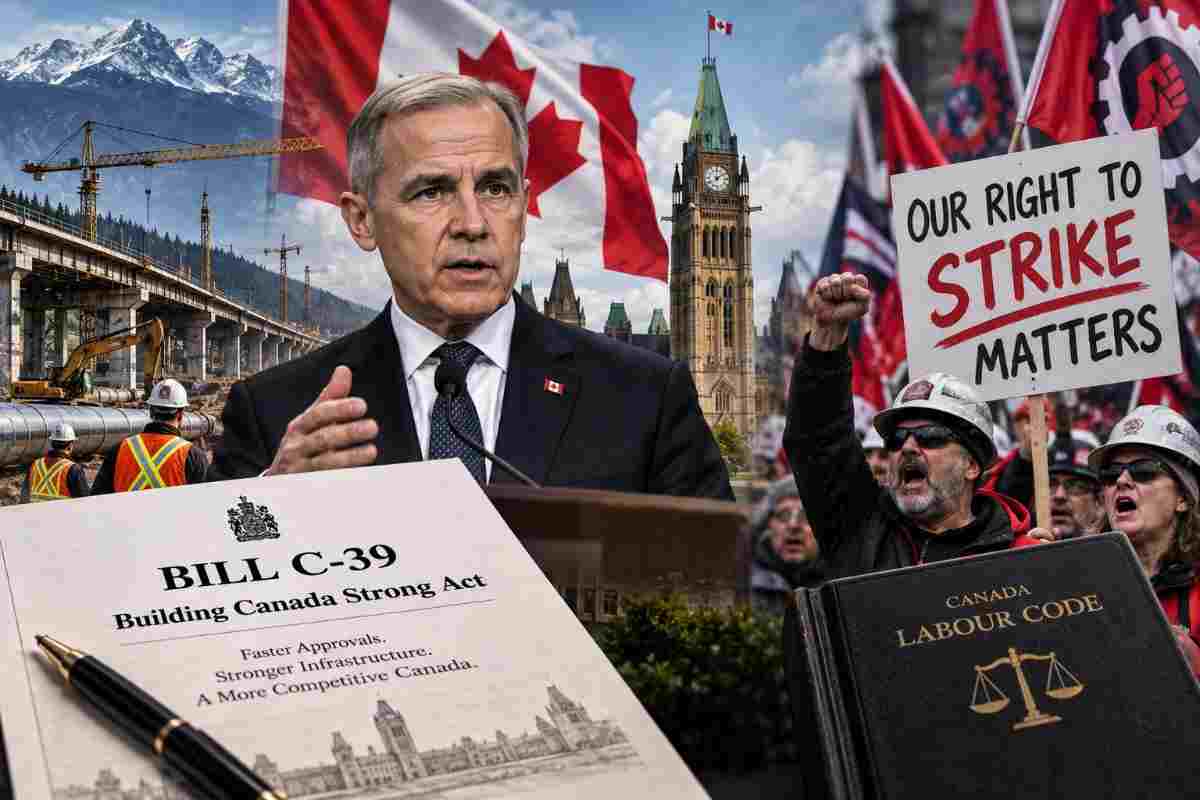
Subheading: Bill C-39 would accelerate federal approvals for major infrastructure and energy projects while changing how Ottawa can intervene in federally regulated labour disputes.
Ottawa Introduces Building Canada Strong Act
Prime Minister Mark Carney’s Liberal government has introduced Bill C-39, the Building Canada Strong Act, a sweeping economic bill designed to speed up major infrastructure approvals, strengthen trade corridors and modernize federal labour rules.
The legislation was tabled in the House of Commons on September 21 as Parliament returned for its fall sitting. The government says the bill is intended to give investors greater certainty, accelerate construction and strengthen Canada’s economy while maintaining environmental protections and Indigenous rights.
The proposed legislation covers several areas, including major-project approvals, transportation infrastructure, ports, digital trade and the Canada Labour Code.
Government Wants Major Projects Built Faster
A central part of Bill C-39 is an effort to reduce the time required for federal reviews of major projects.
The government says federal reviews and decisions would generally be completed within one year once a project proponent submits a comprehensive application. The legislation would also create clearer processes for projects considered to be in the national interest.
Ottawa says faster approvals could help unlock investment in energy, infrastructure and natural resources while strengthening Canada’s supply chains.
The legislation would also establish mechanisms to identify strategic trade corridors and create a Transportation Project Office intended to coordinate federal approvals for priority transportation projects.
Labour Code Changes Become a Major Flashpoint
The labour provisions have generated particular attention from unions.
Bill C-39 proposes changes to Section 107 of the Canada Labour Code, a provision that allows the federal government to intervene in certain labour disputes and refer them to the Canada Industrial Relations Board.
The government says the changes would establish a higher threshold for intervention and encourage mediation before Ottawa considers using its powers to end a strike or lockout. A mediator would have to report that intervention is warranted and that the dispute is of national importance before the government could take action under the proposed framework.
The government says the objective is to reduce the need for direct intervention rather than eliminate workers’ right to strike.
Unions Raise Concerns About Workers’ Rights
Labour organizations have expressed concern that the proposed changes could nevertheless make it easier for the government to restrict legal strikes in strategically important sectors.
The Canadian Labour Congress has argued that the ability to withdraw labour is an important part of collective bargaining. Labour leaders have warned that giving Ottawa additional mechanisms to prevent or end work stoppages could weaken workers’ negotiating position.
Those concerns follow several high-profile federal interventions in labour disputes involving sectors such as railways and ports in recent years.
Union criticism has therefore focused not only on what the legislation formally says about the right to strike, but also on how the new intervention process could operate in practice.
Government Says Right to Strike Will Remain
Federal ministers have rejected the characterization that the legislation would remove or abolish the right to strike.
Jobs and Families Minister Patty Hajdu said the bill is intended to strengthen collective bargaining by encouraging unions and employers to resolve disputes earlier and reach negotiated agreements.
The government says the proposed changes would make federal intervention more difficult by adding conditions that must be satisfied before Ottawa can act.
The legislation would also introduce additional mediation measures intended to help resolve disputes before they escalate into prolonged work stoppages.
More Resources for Workplace Safety
Bill C-39 includes other measures affecting federally regulated workers.
The government plans to add 100 health and safety officers, which it says would increase inspection capacity by about 70%. It also plans to add 26 employees to the Canada Industrial Relations Board to help address a backlog of complaints filed by workers against employers.
Ottawa says the additional resources are intended to strengthen workplace protections and improve the federal labour-relations system.
The bill also proposes measures aimed at addressing worker misclassification and modernizing labour protections.
Why the Bill Matters to Canada’s Economy
The legislation comes as the Carney government attempts to increase investment and make Canada less vulnerable to external economic shocks.
Ottawa has been promoting new infrastructure, energy projects, trade routes and natural-resource development while seeking greater access to international markets.
The government argues that lengthy approval processes can delay investment and construction. Bill C-39 is intended to create clearer timelines and greater certainty for companies considering major projects in Canada.
The labour provisions are being presented as part of the same broader strategy: reducing prolonged disruptions while encouraging employers and unions to settle disputes through negotiation and mediation.
Parliamentary Debate Expected
Bill C-39 is now entering the parliamentary process and is expected to face substantial debate.
The legislation combines economic, infrastructure and labour reforms in a single package, meaning different groups are likely to focus on different aspects of the bill.
Supporters of the labour changes are expected to emphasize the proposed mediation process and higher threshold for government intervention, while unions are likely to continue pressing Ottawa for stronger guarantees around collective-bargaining rights.
The infrastructure provisions will also face scrutiny over environmental assessments, Indigenous consultation and the powers given to ministers and federal authorities.
What Happens Next
The bill must go through the normal parliamentary process, including debate, committee study and votes in the House of Commons before it can become law.
The government will also face pressure to explain how the new approval timelines will work in practice and how Ottawa will balance faster project development with environmental safeguards and Indigenous rights.
On the labour side, the central question will be how the new Section 107 framework operates when a major federally regulated dispute is considered to have broader economic consequences.
Conclusion
The Building Canada Strong Act represents one of the Carney government’s major economic initiatives since Parliament returned for its fall session.
Bill C-39 seeks to accelerate major infrastructure and energy projects, strengthen trade corridors and modernize Canada’s federal labour framework. At the same time, its proposed changes to strike-intervention rules have opened a significant debate between the government and organized labour.
Ottawa says the legislation will protect the right to strike while making collective bargaining more effective and reducing the need for government intervention. Labour organizations argue that the new framework could still affect workers’ bargaining power.
As Parliament begins examining the bill, the debate over how Canada can build major projects faster while protecting collective-bargaining rights is likely to remain at the centre of the discussion.