

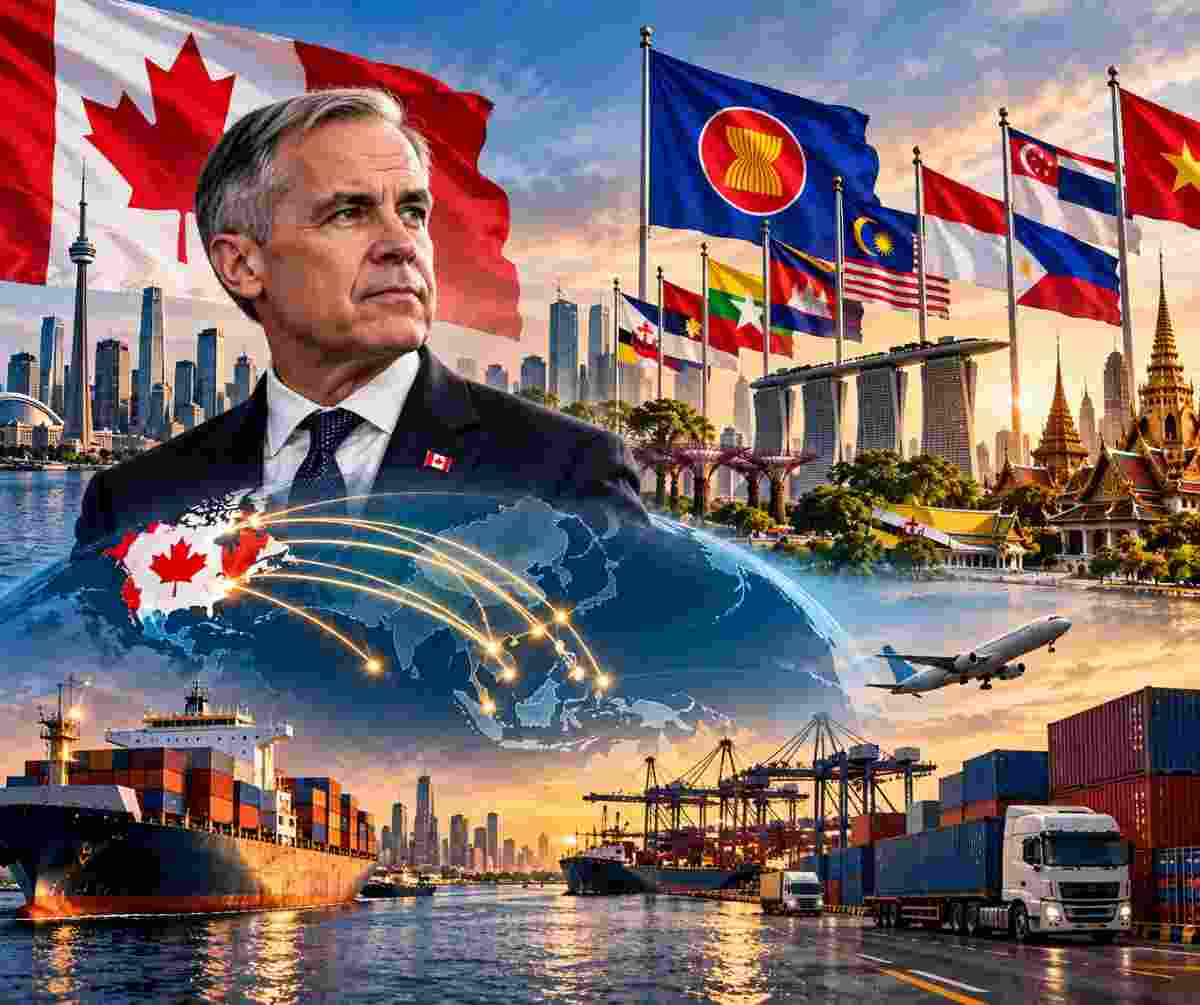
With Canada-ASEAN trade rising and a free-trade agreement moving closer to completion, Mark Carney’s government is looking toward Southeast Asia for markets, investment and a more diversified economy
By CK Sharma
For decades, Canada’s economic relationship with the United States has been difficult to ignore. Geography, supply chains and the sheer size of cross-border trade have made the U.S. central to the Canadian economy.
But Ottawa is increasingly looking beyond its southern neighbour.
Southeast Asia is becoming one of the most important parts of that strategy.
Canada is pushing forward with negotiations for a free-trade agreement with the Association of Southeast Asian Nations (ASEAN), while simultaneously strengthening individual relationships with countries such as the Philippines, Vietnam and Singapore.
The numbers are already attracting attention. In 2025, Canada-ASEAN merchandise trade reached C$52.5 billion, up 23.7% from C$42.4 billion in 2024. ASEAN was Canada’s fifth-largest merchandise trading partner as a group.
So, is ASEAN becoming the next major opportunity in Canada’s global trade strategy?
Canada Is Turning Toward Southeast Asia
The latest moves suggest that Ottawa is no longer treating Southeast Asia as a secondary market.
Canada’s Trade Minister Maninder Sidhu traveled to Manila in September to advance negotiations with both ASEAN and the Philippines. Canadian and ASEAN officials said negotiations toward an ASEAN-Canada Free Trade Agreement had made significant progress and remained on track for a substantive conclusion in 2026.
Reuters reported on September 22 that Canadian officials considered the negotiations with ASEAN and the Philippines more than 90% complete, with Ottawa hoping to finalize them around November.
That timing is significant.
A completed agreement could give Canadian exporters clearer access to a region containing some of the world’s fastest-growing economies.
But the bigger story is not simply about tariffs.
It is about Canada’s attempt to build a wider economic network.
Why ASEAN Matters to Canada
ASEAN consists of 11 Southeast Asian countries, including Indonesia, Vietnam, Singapore, Malaysia, Thailand and the Philippines.
Together, they represent a large and increasingly important consumer and manufacturing market.
For Canada, the region offers opportunities across several sectors.
Energy is one.
Canada is developing new LNG export capacity on its Pacific coast, potentially giving Canadian energy producers greater access to Asian markets. Canadian officials have specifically identified energy diversification as part of the country’s broader engagement with Southeast Asia.
Agriculture is another.
Canada is already a major exporter of agricultural commodities, and growing populations and changing consumption patterns across Southeast Asia could create additional demand for Canadian products.
Then there are critical minerals, infrastructure, aerospace, defence and digital technology.
Ottawa’s engagement with the Philippines illustrates how broad the strategy has become. Canada and the Philippines have been working toward a bilateral trade agreement while also cooperating in areas including energy, mining, infrastructure, digital technologies, space and defence.
The Philippines Could Become a Key Gateway
Among ASEAN countries, the Philippines is becoming particularly important for Canada.
Bilateral merchandise trade reached C$3.4 billion in 2025, according to Canada’s government, while Canadian investment in the Philippines increased significantly during the year.
Canada has also joined the Luzon Economic Corridor Partnership, which is aimed at developing infrastructure and economic connectivity in the Philippines.
Ottawa sees opportunities in areas such as transportation, energy, digital infrastructure and advanced industries.
The Philippines can therefore serve as more than simply another export market. It could become part of Canada’s wider Indo-Pacific economic strategy.
Vietnam and Singapore Are Also Moving Up the List
Canada’s strategy is not limited to Manila.
Vietnam is another increasingly important partner.
Canadian merchandise exports to Vietnam increased by 30.2% in 2025, according to Global Affairs Canada. Recent discussions between the two countries have focused on sectors including energy, aerospace, agriculture and agri-food.
Singapore offers a different opportunity.
As a major financial, logistics and technology hub, Singapore can provide Canadian companies with access to regional supply chains and investment networks.
In September, Canada and Singapore signed a joint statement establishing an Economic Partnership Framework covering investment, emerging technologies, energy, food security and resilient supply chains.
Together, these relationships show that Canada’s Asia strategy is becoming broader than a single trade agreement.
Is This About the United States?
It would be easy to describe Canada’s move toward ASEAN as simply a reaction to tensions with Washington.
But that would leave out an important part of the story.
Canada has been pursuing deeper Indo-Pacific relationships for several years. Its Indo-Pacific Strategy, launched in 2022, committed C$2.3 billion across areas including security, trade and regional engagement. Canada and ASEAN also established their Strategic Partnership in 2023.
What has changed is the urgency.
With global trade becoming more uncertain and businesses increasingly concerned about concentrated supply chains, diversification has become a much bigger priority.
The Canadian government has said it wants to double its non-U.S. exports over the next decade. The ASEAN market is one part of that effort.
That does not mean Canada is abandoning the United States.
Instead, Ottawa appears to be trying to ensure that Canadian companies have more destinations for their products, more sources of investment and more resilient supply chains.
The Energy Opportunity
Energy could become one of the most important pieces of Canada’s Asia strategy.
Southeast Asian economies are seeking reliable energy supplies as their populations and industries expand.
Canada, meanwhile, has significant natural resources and is expanding its ability to export LNG from the Pacific coast.
That creates a potential match.
Canadian officials have highlighted LNG and energy diversification as areas of opportunity in their engagement with Asian markets.
But turning that potential into major trade flows will require infrastructure, long-term contracts and competitive pricing.
Geography also matters.
Canada is much farther from Southeast Asia than it is from the United States, meaning transportation costs and logistics will remain important factors for Canadian exporters.
The Free-Trade Agreement Could Change the Equation
The proposed ASEAN-Canada Free Trade Agreement could therefore become an important test.
If negotiations conclude in 2026, the agreement could improve market access and establish clearer rules for Canadian businesses operating across Southeast Asia.
But a trade agreement alone does not guarantee a dramatic increase in exports.
Canadian companies would still need to invest, establish distribution networks and compete with suppliers from countries that already have deep commercial relationships in the region.
The European Union’s recent trade push in Southeast Asia also shows how competitive the market is. Brussels has been negotiating and concluding agreements with several ASEAN countries, increasing competition for access to the region.
Canada will therefore have to compete not only with the United States and China, but also with Europe, Japan, South Korea and Australia.
Could ASEAN Become Canada’s Next Major Trade Partner?
The answer is still uncertain.
ASEAN is already Canada’s fifth-largest merchandise trading partner as a group, and trade is growing quickly. The proposed free-trade agreement could further strengthen that relationship.
But the United States remains deeply embedded in Canada’s economy, and replacing that scale of trade is not the objective of the current policy.
A more realistic possibility is that ASEAN becomes one of several major pillars of Canada’s broader trade strategy.
Europe, India and the Indo-Pacific could increasingly complement Canada’s existing North American economic base.
That would give Canadian businesses more options without requiring Ottawa to choose one region over another.
Conclusion
Canada’s growing engagement with ASEAN is more than another diplomatic initiative.
Trade with the region is rising. Free-trade negotiations are advancing. Canada is pursuing closer relationships with the Philippines, Vietnam and Singapore while looking for opportunities in energy, agriculture, critical minerals, technology and infrastructure.
The biggest question is whether Ottawa can turn that diplomatic momentum into lasting commercial results.
If it can, Southeast Asia could become a much more important part of Canada’s economy over the next decade.
Canada is not walking away from America.
But it is clearly looking for more doors to open.
And Southeast Asia may be one of the biggest doors Ottawa is trying to unlock.