

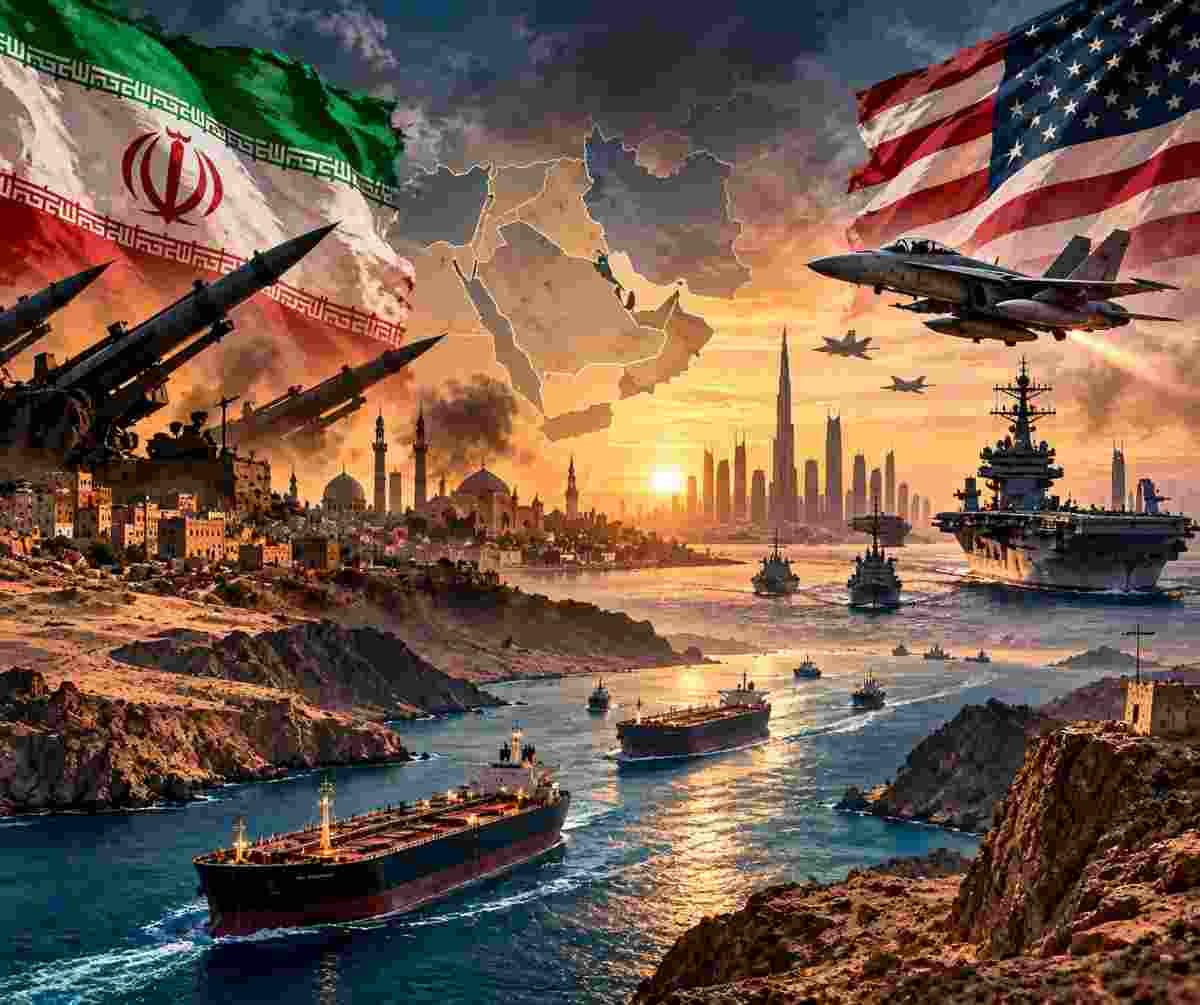
As the U.S.-Iran conflict reshapes Gulf security, energy routes and regional alliances, the Middle East could emerge very different from the one that entered the war
By CK SHARMA TORONTO ( EDITOR IN CHIEF )
The Middle East is being reshaped by a conflict whose consequences extend far beyond the battlefields of Iran.
The war between the United States and Iran is still continuing, while diplomatic efforts are underway to explore a possible path toward de-escalation. At the same time, fighting involving Iran-backed Houthi forces and Saudi Arabia has added another layer of uncertainty to an already fragile regional security environment.
That makes one question increasingly important: what will the Middle East look like when the Iran war eventually ends?
The answer may depend on much more than the final terms of a U.S.-Iran agreement. The conflict has already affected oil markets, shipping routes, Gulf security, relations between regional powers and the balance between the United States, China and other major players.
If those changes continue after the fighting stops, the Middle East could enter a new geopolitical phase.
The Strait of Hormuz Has Become a Global Pressure Point
One of the biggest consequences of the war has been the disruption around the Strait of Hormuz, one of the world’s most important energy corridors.
Before the conflict, the waterway carried a significant share of global oil and gas shipments. During the war, vessel traffic through Hormuz dropped sharply. Reuters reported that only 17 commodity vessels crossed the strait over one weekend, compared with a pre-war average of roughly 125 vessels a day.
The disruption has demonstrated something that Gulf countries and global energy consumers already understood: control and security of maritime chokepoints can have consequences far beyond the Middle East.
Iran has also indicated that it could reopen the Strait of Hormuz if the United States reduces military pressure and lifts its blockade, suggesting that the waterway could become part of any future diplomatic settlement.
Even if shipping eventually returns to normal, governments and companies may rethink how dependent their economies are on a small number of strategic routes.
Saudi Arabia Faces a New Security Challenge
The war has also changed the security calculations of Saudi Arabia.
The conflict between Saudi Arabia and Iran-backed Houthi forces in Yemen has intensified, with Houthi attacks reaching Saudi cities and energy infrastructure. On September 25, Saudi, Turkish and Pakistani military chiefs were due to discuss possible assistance for Saudi Arabia as attacks continued.
This is significant because Riyadh has spent years trying to protect its economic transformation plans from regional instability.
Saudi Arabia’s Vision 2030 strategy depends heavily on investment, tourism, infrastructure and economic diversification. A prolonged regional security crisis could complicate those ambitions.
At the same time, Riyadh has demonstrated that it has alternatives for exporting some of its oil. Its East-West pipeline, which connects the Gulf to the Red Sea, was restarted after a drone attack temporarily shut it down. The pipeline can help reduce Saudi dependence on the Strait of Hormuz, although restoring full capacity could take time.
The lesson for Gulf states is becoming clearer: energy security and military security are increasingly connected.
Yemen and the Red Sea Could Become More Important
The Iran war has also changed the strategic importance of Yemen.
Iran-backed Houthi forces have made major gains along Yemen’s Red Sea coast and around the Bab al-Mandeb area. The waterway connects the Red Sea with the Gulf of Aden and is an important route for international shipping.
That creates a difficult strategic situation.
Even if the Strait of Hormuz becomes fully operational again, instability around Bab al-Mandeb could continue affecting shipping between Asia and Europe.
For global businesses, this means that the risks associated with Middle Eastern conflict are no longer limited to one country or one waterway. The security of multiple maritime corridors has become part of the same broader geopolitical calculation.
Will the United States Remain the Dominant Power?
The United States is likely to remain a major military and diplomatic force in the Middle East, but the conflict may also encourage regional governments to diversify their relationships.
Gulf states have traditionally relied heavily on U.S. security partnerships while maintaining economic relationships with countries such as China and India.
The war could make that balancing act even more important.
China, in particular, has significant economic interests in the Gulf and is a major energy importer. AP reported that China’s large oil reserves and ability to manage its energy supplies helped prevent the conflict from producing an even more severe global oil shock.
That does not mean China is replacing the United States in Middle Eastern security. Rather, it demonstrates how economic influence and energy relationships can give Beijing an important role even when Washington remains the dominant military power.
A More Independent Gulf?
Another possible consequence is that Gulf countries may seek greater strategic autonomy.
Saudi Arabia, the United Arab Emirates, Qatar and other regional states have strong reasons to maintain relationships with Washington. But the experience of the war could encourage them to strengthen ties with multiple major powers simultaneously.
That could include deeper economic relations with China, stronger diplomatic links with Europe and continued engagement with India and other Asian economies.
Such a strategy would not necessarily mean abandoning the United States.
Instead, it could mean avoiding excessive dependence on any single major power.
For middle powers, diversification can become a form of strategic insurance.
Iran’s Position After the War Will Matter
Perhaps the biggest unanswered question concerns Iran itself.
The war has placed enormous pressure on Tehran, but the final outcome will influence whether Iran emerges more isolated or whether diplomacy creates a new regional arrangement.
The possibility of negotiations remains open. Reuters reported on September 25 that Washington and Tehran were discussing a possible phased arrangement involving the reopening of the Strait of Hormuz and an end to the U.S. blockade.
If diplomacy eventually produces an agreement, the post-war environment could focus on sanctions, reconstruction, regional security guarantees and the future of Iran’s relationship with its neighbours.
If diplomacy fails, however, the region could remain trapped in a cycle of escalation.
That uncertainty is one of the most important factors shaping the Middle East today.
The Global Economic Impact
The consequences of the Iran war are not limited to regional politics.
Oil prices, shipping costs, insurance premiums and supply chains have all been affected by instability around the Gulf and Red Sea.
On September 25, oil prices fell as markets considered the possibility of a U.S.-Iran truce, although concerns about attacks on Saudi Arabia continued to support risk premiums.
This illustrates how quickly geopolitical developments can influence the global economy.
For countries that depend heavily on imported energy, the conflict is a reminder that energy security is also national economic security.
It could accelerate investment in alternative suppliers, renewable energy, strategic reserves and new transportation routes.
Is a New Middle East Emerging?
It is too early to say that the Iran war has created a completely new Middle East.
But several changes are already visible.
Regional countries are paying greater attention to independent defence capabilities. Gulf governments are thinking more carefully about energy and shipping security. China is becoming increasingly important economically. The United States remains deeply involved, but regional governments have incentives to maintain relationships with several global powers.
The result could be a more complicated and more multipolar Middle East.
Rather than one dominant external power shaping every major regional decision, several countries could compete and cooperate simultaneously across security, trade, energy and diplomacy.
Conclusion
The Iran war may eventually end through diplomacy, military exhaustion or a broader political settlement. But the geopolitical consequences are likely to last much longer than the fighting itself.
The importance of the Strait of Hormuz has been reinforced. The security of Saudi Arabia and other Gulf states has become even more closely connected to developments in Yemen and Iran. China and other major economic powers have additional reasons to deepen their engagement with the region.
The biggest change may therefore be psychological as much as military.
Middle Eastern governments have seen how quickly a regional conflict can disrupt global energy and trade. That experience could push them toward stronger defence capabilities, wider diplomatic partnerships and greater economic diversification.
The Middle East may not be entering a completely new geopolitical era yet—but the foundations for one are already being laid.