

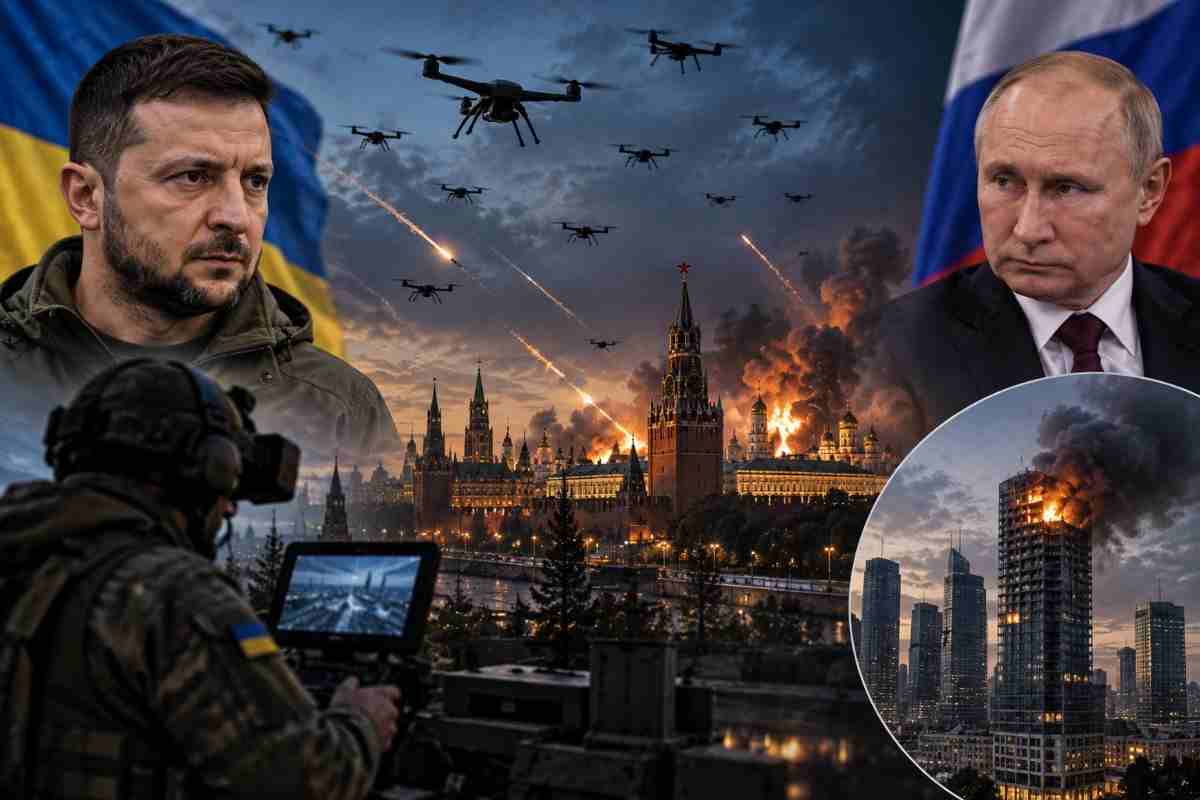
Subheading: Hundreds of drones targeted Moscow and the surrounding region on the final day of Russia’s parliamentary elections, killing two people and damaging an oil refinery, according to Russian authorities.
Moscow Faces Massive Overnight Drone Assault
Moscow and the surrounding region came under an unprecedented wave of Ukrainian drone attacks on Sunday, September 20, with Russian authorities reporting that more than 1,600 drones had been intercepted since Saturday.
Moscow Mayor Sergei Sobyanin described the assault as the largest drone attack on the Russian capital to date, saying around 450 drones had been directed toward Moscow. Russian authorities said the attack was largely repelled, but several drones reached targets in the capital and surrounding region.
The attack came on the final day of Russia’s three-day parliamentary elections, adding a major security incident to an already politically significant weekend.
Two People Killed in Moscow Region
Authorities in the Moscow region reported that two people were killed and several others injured during the attacks.
Regional Governor Andrei Vorobyov said residential buildings and other structures were damaged, while around 400 people, including children, were evacuated from an apartment building in the Ramenskoye district after a drone-related incident.
Russian officials also reported damage to residential property in the region. The full extent of the damage was still being assessed as emergency services responded to fires and debris.
Moscow Oil Refinery Damaged
One of the most significant reported targets was an oil refinery in Moscow.
Sobyanin said several drones reached the refinery premises and that part of the facility was damaged. Reuters witnesses reported hearing explosions and seeing smoke rising from the refinery area.
The facility has previously been targeted during the war and is an important part of Moscow’s fuel infrastructure. According to data cited by Reuters, the refinery processed about 11.6 million metric tons of crude oil in 2024, producing millions of tons of gasoline and diesel.
Repeated attacks on Russian refineries have already contributed to disruptions in fuel production and tighter supplies in parts of the country.
Russia Says Attack Was Intended to Disrupt Election
Sobyanin said the scale and timing of the assault indicated that the attack had been intended to disrupt Russia’s parliamentary elections.
The Russian mayor said the attack failed to achieve that objective and that voting continued despite the drone strikes. Russian authorities have also accused Ukraine of attempting to interfere with the election.
Ukraine has not officially claimed responsibility for the Moscow attacks in the initial reports. Ukrainian President Volodymyr Zelenskyy did, however, say that Ukrainian forces had used domestically produced missiles and drones to strike Russian oil and logistics facilities. He described the targets as sources of revenue supporting Russia’s war effort.
Attack Comes Amid Wider Energy Campaign
The Moscow strikes are part of a broader Ukrainian campaign against Russian energy infrastructure.
Ukraine has increasingly used long-range drones to target oil refineries, fuel depots and other facilities that Kyiv says contribute to Russia’s military capacity.
The attacks have caused disruptions to Russian refining operations and have contributed to fuel shortages and higher prices in some regions. Moscow has responded with measures including restrictions on fuel exports.
Both Russia and Ukraine have repeatedly targeted energy infrastructure during the conflict, despite recent efforts to establish a pause in attacks against such facilities.
Russia Also Launches Attacks on Ukraine
The latest assault on Moscow occurred alongside another night of Russian attacks against Ukraine.
Ukrainian authorities reported that Russian drones struck the Kyiv region, killing four civilians, including three children. Several residential, industrial and utility sites were also damaged.
The simultaneous attacks underline the continuing escalation of long-range drone warfare, with both sides increasingly using unmanned systems to strike targets far behind the front lines.
Elections Take Place Under Heavy Security
The drone assault occurred as Russia completed its first parliamentary election since the full-scale invasion of Ukraine in 2022.
The three-day vote was taking place across Russia as well as in territories that Ukraine and much of the international community regard as illegally occupied. Russian authorities reported that voting continued despite drone attacks and other security incidents.
The Kremlin has presented the election as an opportunity to demonstrate public support for President Vladimir Putin and his policies during the war.
Ukrainian authorities, meanwhile, have dismissed the vote in occupied Ukrainian territories as illegitimate.
Drone Warfare Enters a New Phase
The scale of the latest assault highlights how drone warfare has expanded during the conflict.
Rather than concentrating attacks only on military positions near the front, Ukraine has increasingly attempted to strike oil refineries, logistics centres and other strategic infrastructure deep inside Russia.
For Moscow, the growing frequency and scale of these attacks presents a challenge for air-defence systems and civilian infrastructure protection.
For Kyiv, attacks on energy and logistics facilities are intended to increase the economic costs of Russia’s war effort.
Conclusion
Ukraine’s latest drone offensive against Moscow represents one of the largest aerial attacks on the Russian capital since the beginning of the full-scale war.
Russian authorities said more than 1,600 drones had been intercepted across the country since Saturday, including hundreds headed toward Moscow. Two people were killed in the Moscow region, while an oil refinery and residential buildings were damaged.
The timing of the assault, on the final day of Russia’s parliamentary elections, has added a political dimension to the attack, although Ukraine has not officially confirmed responsibility for the Moscow strikes.
With both sides continuing to target infrastructure far from the front lines, the latest attacks demonstrate how the Russia-Ukraine conflict is increasingly being fought through long-range drones and strikes against critical economic facilities.