

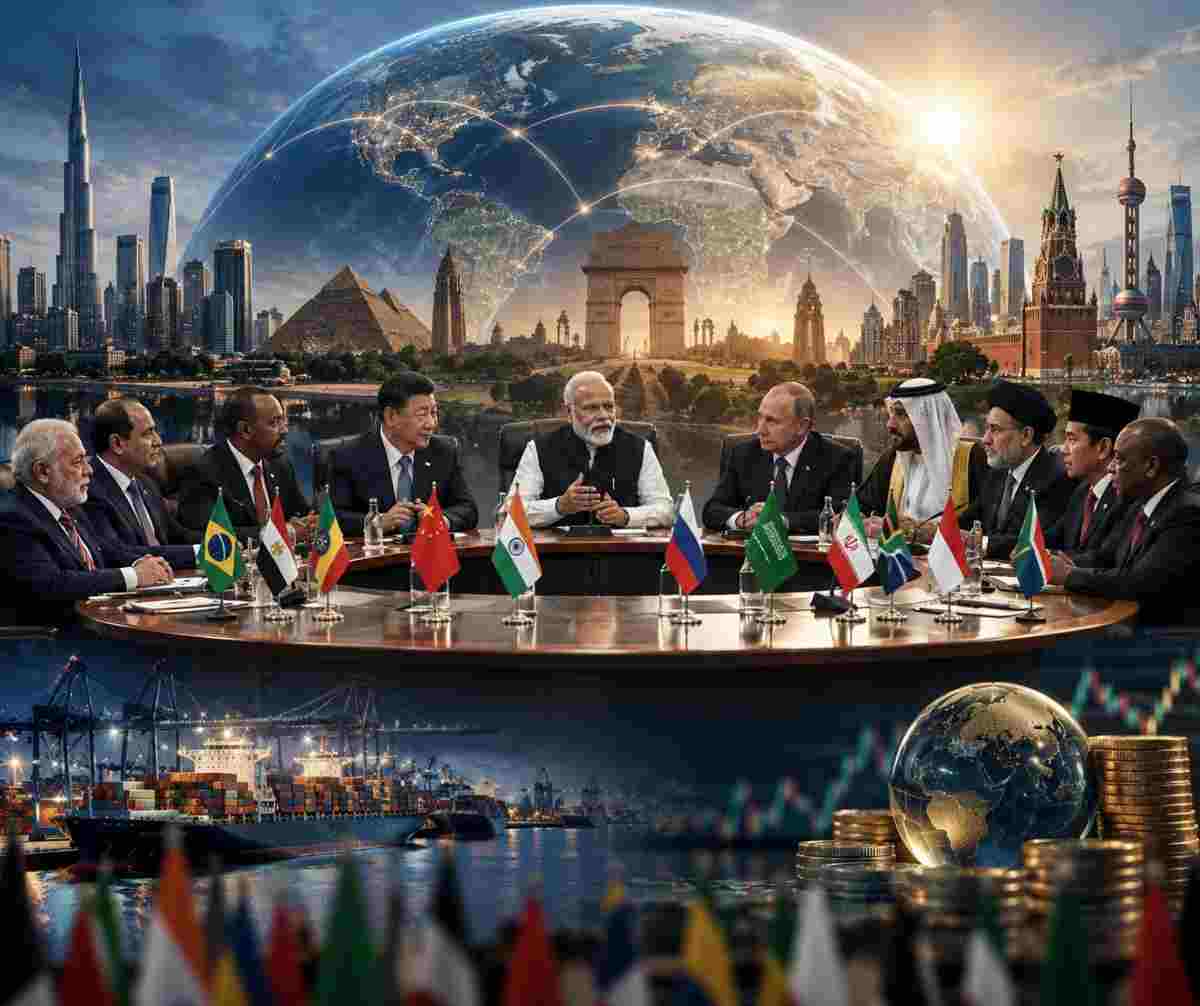
India’s BRICS presidency ends with a push for greater Global South representation, but divisions within the expanded bloc show that changing the world economy will not be straightforward
By CK Sharma
Summary
The 2026 BRICS Summit in New Delhi has renewed an important question about the future of the global economy: is the balance of economic and political influence beginning to shift? Leaders of the expanded 11-member grouping met in New Delhi on September 12 and 13, where they adopted the New Delhi Declaration and called for reforms to global institutions, stronger cooperation among emerging economies and a greater voice for developing countries. The declaration also backed reforms to the International Monetary Fund and World Bank and highlighted the growing importance of emerging and developing economies.
But the summit also showed the limits of BRICS. Its members have very different political priorities, economic interests and relationships with the United States and Europe. That makes the group an increasingly important platform, but not yet a unified alternative to the existing global economic system.
BRICS Is No Longer the Group It Once Was
When BRICS first emerged, it was a relatively small grouping of Brazil, Russia, India and China, later joined by South Africa. Its original focus was largely economic: the members wanted greater recognition for emerging economies whose influence was growing faster than their representation in global institutions.
The group looks very different today.
BRICS now has 11 members, including Egypt, Ethiopia, Iran, Indonesia, Saudi Arabia and the United Arab Emirates. Together, the grouping represents a substantial share of the world’s population and around 40 per cent of global GDP at purchasing power parity.
That expansion has changed the significance of the bloc.
It is no longer simply a meeting of five emerging economies. BRICS now brings together major energy producers, manufacturing powers, large consumer markets and some of the world’s fastest-growing economies.
The question is whether that size can be converted into lasting economic influence.
What India Put on the Table
India used its 2026 BRICS presidency to push the idea of a more representative international system.
The New Delhi Declaration called for reforms to global economic governance and argued that the institutions created under the Bretton Woods system should better reflect the current weight of emerging and developing economies. The declaration specifically called for greater representation of emerging and developing countries in institutions such as the IMF and World Bank.
This is not a new demand from BRICS countries.
For years, developing economies have argued that their growing contribution to global economic output has not been matched by their influence within international financial institutions.
What has changed is the scale of the countries making that argument.
With BRICS expanding, the demand for a larger voice from the Global South is becoming harder to ignore.
But BRICS Is Not a Single Economic Team
This is where the picture becomes more complicated.
The countries sitting around the BRICS table do not necessarily agree on major geopolitical or economic questions.
India has deep economic and strategic relationships with the United States and Europe. China is America’s biggest strategic competitor in several areas. Russia remains under extensive Western sanctions. Gulf members such as Saudi Arabia and the UAE maintain strong commercial relationships with both Western and Asian economies.
Those differences were visible during the New Delhi summit.
The group adopted a common declaration despite disagreements over conflicts in the Middle East and Ukraine. Reporting from the summit noted that BRICS members avoided directly naming individual countries in some of the most sensitive areas, allowing the expanded group to maintain consensus despite significant differences.
That may actually be one of BRICS’ greatest strengths.
Instead of requiring every member to agree on foreign policy, the group can concentrate on areas where their interests overlap, such as trade, development, technology, energy and financial cooperation.
India and China Send Another Important Signal
One of the most significant developments around the summit happened outside the main BRICS discussions.
Indian Prime Minister Narendra Modi and Chinese President Xi Jinping met on the sidelines of the summit as both countries looked to improve ties after years of tension along their disputed Himalayan border.
The two leaders discussed improving business and transport links, expanding market access and addressing trade and supply-chain issues. Bilateral trade between India and China reached a record $155.6 billion in 2025, although India continues to run a large trade deficit with China.
The meeting does not erase the disagreements between the two countries.
Military deployments along the border remain an important concern, and negotiations over the boundary have not been completely resolved. But renewed economic engagement between the world’s two most populous countries could have consequences beyond their bilateral relationship.
If India and China can expand practical economic cooperation while managing their political differences, BRICS could become a more useful platform for trade and investment.
Is BRICS Trying to Replace the Dollar?
This is perhaps the most misunderstood part of the BRICS debate.
There has been considerable discussion about whether BRICS could eventually create an alternative to the US dollar or build a completely separate global financial system.
The reality is more complicated.
The New Delhi Declaration focuses heavily on reforming existing institutions and strengthening financial cooperation rather than announcing the creation of a new global currency that would immediately challenge the dollar. The declaration also continues to recognise the G20 as an important forum for international economic cooperation.
That distinction matters.
BRICS may be seeking more options in international finance, greater use of local currencies and stronger financial institutions for emerging economies. But that is different from replacing the dollar overnight.
The US dollar remains deeply embedded in global trade, finance and central-bank reserves. Changing that system would require much more than political agreement among BRICS members.
Trade Is Becoming a Major Battleground
The BRICS discussion comes at a time when international trade itself is changing.
Tariffs, supply-chain disruptions, technology restrictions and competition over critical industries are pushing governments to reconsider their dependence on foreign markets.
For BRICS countries, this creates both an opportunity and a challenge.
The larger the group’s internal market becomes, the greater the potential for members to increase trade with one another. Cooperation in areas such as energy, food security, technology and supply chains could reduce some vulnerabilities.
But increasing trade within BRICS does not mean abandoning Western markets.
India, China, Brazil, Saudi Arabia and other members continue to depend heavily on trade with countries outside the grouping.
The future is therefore more likely to involve diversification than complete separation.
The Global South Wants a Bigger Voice
Perhaps the most important message from the New Delhi summit was political rather than financial.
BRICS leaders repeatedly called for a more representative international system and greater participation by emerging and developing economies.
Prime Minister Narendra Modi argued that the Global South should become more involved in shaping international rules rather than simply following them. The summit declaration similarly called for reforms that would give emerging and developing countries greater representation in global institutions.
That reflects a wider change in global politics.
Economic power is no longer concentrated in the same places it was several decades ago. Asia has become central to global manufacturing and trade, while emerging economies in Africa, the Middle East and Latin America are demanding greater influence.
BRICS is one expression of that broader shift.
So, Is the Global Economic Order Changing?
The answer is yes, but probably not in the dramatic way some headlines suggest.
The 2026 BRICS Summit did not create a new global financial system overnight. It did not replace Western-led institutions, nor did it turn BRICS into a unified economic alliance.
What it did demonstrate is that a growing group of emerging economies wants a greater say in how the international economy is governed.
The New Delhi Declaration’s emphasis on reforming the IMF and World Bank, strengthening cooperation among emerging economies and giving the Global South a larger voice reflects that ambition.
The challenge will be turning those ambitions into practical results.
What Comes Next?
The real test for BRICS will come after the summit.
China will take over the group’s presidency in 2027, and the bloc will have to decide how far it wants to push economic cooperation while managing its internal differences.
If members can make progress on trade, investment, development finance, digital cooperation and supply chains, BRICS could gradually become more influential in global economic decision-making.
If disagreements continue to prevent meaningful cooperation, its influence may remain largely political and symbolic.
For India, the challenge is particularly interesting.
New Delhi wants stronger ties with the United States and other Western economies while also maintaining relationships with Russia, China and the wider Global South. BRICS gives India a platform to pursue those interests simultaneously.
Conclusion
The 2026 BRICS Summit did not mark the end of the existing global economic order. But it did offer another sign that the system is becoming more diverse and less centred around a small group of traditional economic powers.
BRICS is larger than it was when the group first emerged, and its members represent a significant portion of the world’s population and economic activity. Their demand for greater representation in institutions such as the IMF and World Bank reflects a wider push from emerging economies to have a stronger role in global decision-making.
At the same time, the summit showed why changing the global order will not be easy. BRICS members have different political systems, economic priorities and relationships with the West. They may agree on the need for reform without agreeing on what should replace the current system.
That may ultimately be the story of BRICS: not the sudden creation of a new world economy, but the gradual emergence of a more multipolar one.
The New Delhi summit has made that transition a little harder to ignore.
CK SHARMA TORONTO ( EDITOR IN CHIEF )