

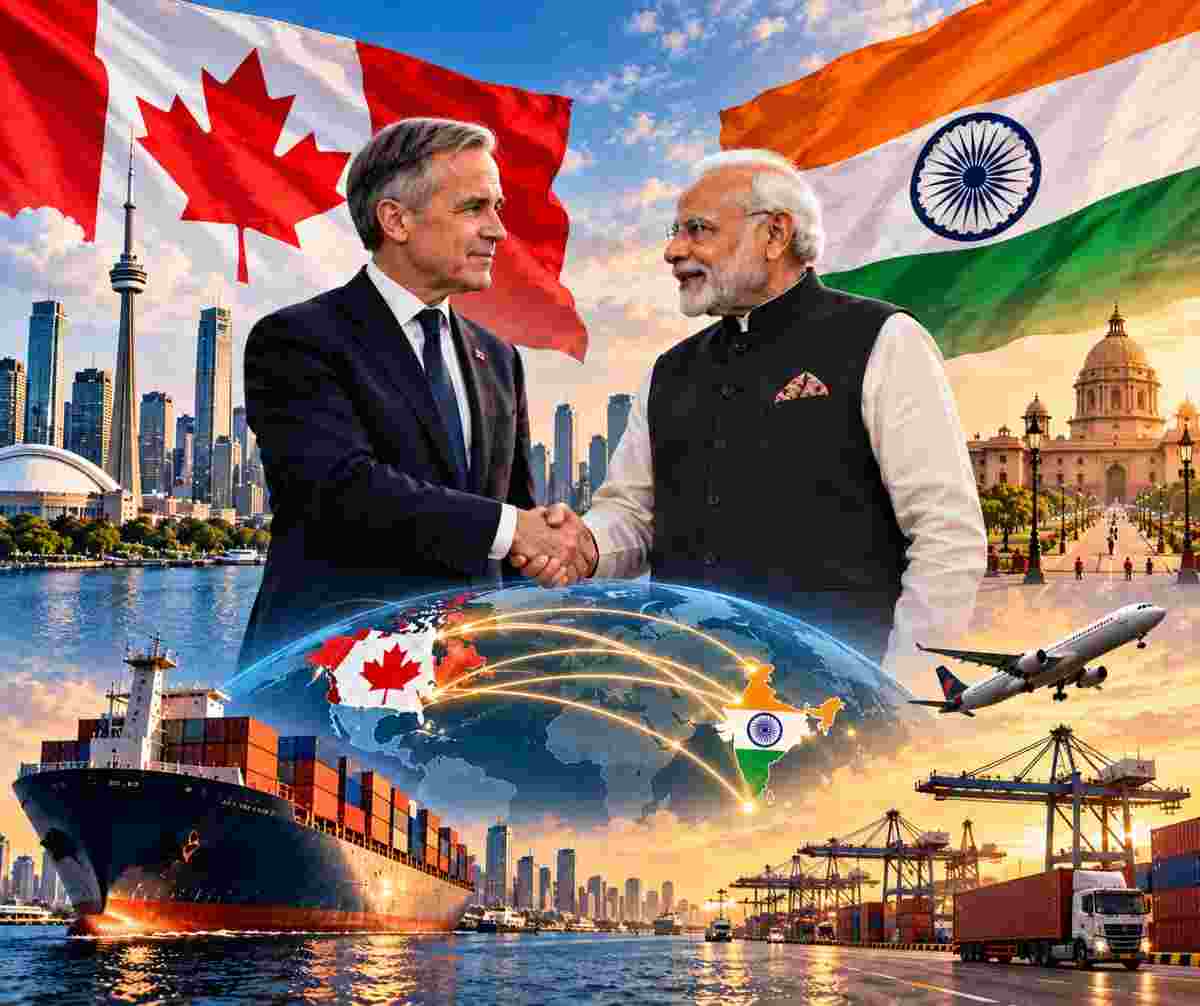
With a major trade agreement still under negotiation, Narendra Modi’s expected Canada visit could become an important test of the new India-Canada relationship
By CK SHARMA TORONTO ( EDITOR IN CHIEF )
For years, the relationship between India and Canada was better known for diplomatic disagreements than economic opportunity.
That picture is changing.
After a period of serious tensions, New Delhi and Ottawa are now working to rebuild their relationship around trade, investment, energy, technology, critical minerals and security cooperation. At the centre of that reset is a proposed Canada-India Comprehensive Economic Partnership Agreement (CEPA).
And now, another potentially important moment is approaching.
Indian Prime Minister Narendra Modi is expected to visit Canada in December 2026, according to a report cited by Reuters, with the possibility that the visit could coincide with efforts to finalize a trade agreement. The exact timing and outcome, however, have not been officially confirmed.
That raises a bigger question:
Could Modi’s Canada visit mark the beginning of a new trade era between India and Canada?
A Relationship That Has Changed Dramatically
The current push is notable because it follows years of difficult relations.
In 2026, Prime Minister Mark Carney made his first bilateral visit to India as Canadian prime minister, traveling to Mumbai and New Delhi in February and March. The visit produced agreements and initiatives covering energy, critical minerals, technology, artificial intelligence, talent, culture and defence.
The two governments have since maintained a steady series of high-level engagements.
At their June meeting on the sidelines of the G7 summit, Carney and Modi reviewed progress in economic cooperation and welcomed continued momentum toward a CEPA. They also discussed commercial opportunities involving LNG, LPG and metallurgical coal.
In September, Canadian Foreign Minister Anita Anand and Indian External Affairs Minister S. Jaishankar also met on the sidelines of the United Nations General Assembly. Both sides highlighted progress under their bilateral roadmap and discussed trade, energy, critical minerals, nuclear energy, defence and technology.
The message from both governments has become increasingly clear: the relationship is being rebuilt around practical economic interests.
The $70 Billion Trade Ambition
The biggest economic headline is the target itself.
Canada and India have set a shared objective of more than doubling bilateral trade to C$70 billion annually by 2030.
That is an ambitious goal.
In 2025, two-way merchandise trade between the two countries reached C$13.6 billion, while total goods and services trade stood at approximately C$30.4 billion. Canadian exports to India were worth C$3.9 billion, while imports from India reached C$9.7 billion.
A successful CEPA could potentially make it easier for businesses in both countries to expand those numbers.
The agreement is expected to address market access and trade rules across a wide range of sectors. But negotiations still have to resolve outstanding differences before anything can be signed.
Canadian Trade Minister Maninder Sidhu said in September that Ottawa remained committed to concluding the CEPA negotiations by the end of 2026. Four rounds of negotiations had been completed at that point.
Why Canada Wants India
For Ottawa, India is becoming increasingly important as Canada tries to diversify its international trade.
Canada has been looking to reduce its dependence on the United States by expanding commercial relationships in Europe and the Indo-Pacific.
India fits naturally into that strategy.
It has one of the world’s largest populations, a rapidly expanding economy and growing demand for energy, technology, infrastructure and industrial materials.
Canadian officials have specifically identified energy, critical minerals, aerospace, artificial intelligence and clean technology as areas with significant potential.
Canada also has resources that India needs.
Critical minerals are increasingly important for batteries, electronics, renewable energy systems and advanced manufacturing. Canada and India signed a memorandum of understanding in 2026 aimed at strengthening cooperation across critical-mineral value chains, including exploration, processing and investment.
Energy could become another major pillar.
During Carney’s March visit to India, Canada and India also highlighted cooperation involving uranium and other energy-related areas. A long-term uranium supply agreement involving Saskatchewan-based Cameco and India’s Department of Atomic Energy was valued at about US$2.6 billion.
And What Does India Gain?
For India, closer economic relations with Canada could provide access to resources, investment and technology while strengthening ties with another major developed economy.
Canada’s energy resources, critical minerals, agricultural products and advanced technologies could complement India’s expanding manufacturing and infrastructure needs.
Indian companies, meanwhile, already have a significant presence in Canada and the broader North American market.
India also has a large services sector, technology industry and growing manufacturing base that could benefit from improved access to Canadian markets.
A trade agreement could therefore create opportunities in both directions rather than simply increasing Canadian exports to India.
The People-to-People Connection
Trade is not the only part of the relationship.
People-to-people ties remain one of the strongest foundations of India-Canada relations.
Canada’s government has described the relationship as being supported by decades of people-to-people connections, while education, talent and mobility have been included in the renewed bilateral roadmap.
That human connection has an economic dimension as well.
Canada’s 2025 services exports to India were valued at C$15.2 billion, with education-related travel representing the largest component.
Any improvement in the broader relationship could therefore affect not only companies and investors, but also students, professionals, researchers and families connected to both countries.
The Diplomatic Reset Still Has Limits
Despite the positive momentum, the relationship is not without challenges.
Canada and India have had serious disagreements over security and law-enforcement issues in recent years. The renewed partnership has therefore been described by Canadian officials as a dual-track approach: strengthening diplomatic and economic ties while continuing practical cooperation on national security and law enforcement.
That means the economic reset should not be confused with the disappearance of every disagreement.
For CEPA to succeed, negotiators still have to bridge differences over market access, tariffs, investment and other trade rules.
The political relationship may be improving, but trade negotiations are ultimately decided by the details.
Could December Become a Turning Point?
This is where Modi’s expected Canada visit becomes particularly interesting.
Reuters reported that Modi is anticipated to visit Canada in December and could potentially finalize a trade agreement. However, the Canadian government’s official statements so far have focused on the shared objective of completing CEPA negotiations by the end of 2026 rather than confirming a specific signing date during a December visit.
That distinction matters.
A high-level visit can create political momentum, but a trade agreement still depends on negotiators resolving the outstanding issues.
If an agreement is completed, however, a Modi visit could give the announcement much greater political significance.
It would demonstrate that the relationship has moved beyond simply repairing diplomatic ties and toward building a long-term economic partnership.
More Than Just a Trade Deal
The potential CEPA should also be viewed in the context of a changing global economy.
Canada is trying to diversify its export markets. India is looking to expand its global economic relationships. Both countries are interested in critical minerals, energy security, technology and resilient supply chains.
Those interests overlap.
Canada has resources and capital. India offers a huge market, manufacturing capacity, technology expertise and a rapidly expanding economy.
That does not guarantee that the two countries will achieve their C$70 billion target.
But it explains why both governments are investing political attention in the relationship.
Conclusion
The expected visit by Narendra Modi to Canada could become an important moment in the evolving India-Canada relationship—but its significance will depend on what happens before and during the visit.
If negotiators successfully conclude the Canada-India CEPA by the end of 2026, the agreement could provide a framework for substantially expanding trade and investment.
Energy, critical minerals, artificial intelligence, aerospace, clean technology, education and services could all become larger parts of the relationship.
For Mark Carney’s government, India offers an opportunity to diversify Canada’s economic relationships beyond its traditional dependence on the United States.
For Narendra Modi’s government, Canada offers resources, investment, technology and another important partner in an increasingly competitive global economy.
The two countries are therefore approaching the same opportunity from different directions.
Whether Modi’s expected Canada visit becomes the moment that seals a new India-Canada trade era remains to be seen. But the groundwork for that possibility is already being laid.